

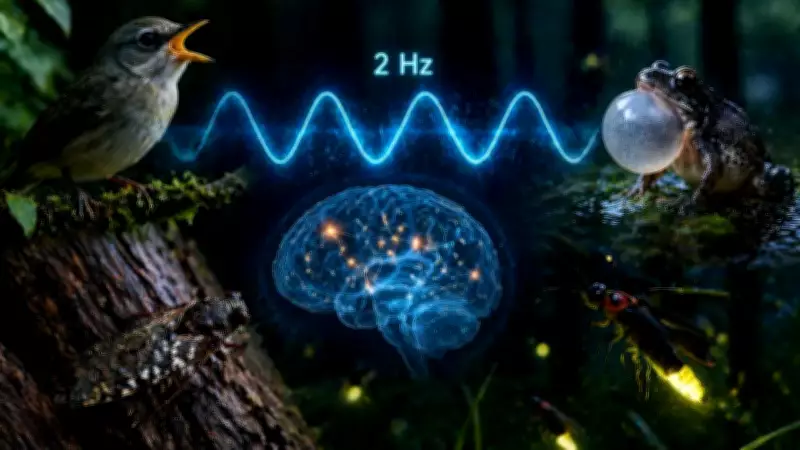
Universal Animal Communication Rhythm Discovered: 2 Hz Pattern Links All Species
Groundbreaking research published in the prestigious journal PLOS Biology has uncovered a remarkable universal rhythm in animal communication. Scientists have discovered that creatures ranging from tiny insects to large mammals share a common timing pattern in their signaling, typically operating at approximately two pulses per second. This finding suggests a fundamental biological constraint that transcends species boundaries and communication methods.
Common Rhythm Across Diverse Communication Modes
The universal rhythm manifests across various communication modalities including vocalizations, physical movements, and even light signals. Whether observing birds chirping in forests, frogs calling in wetlands, or fireflies flashing in meadows, researchers identified this shared rhythm consistently falling within the 0.5 to 4 hertz frequency range. This pattern appears regardless of the specific communication style employed by different species.
Field studies in Thailand provided crucial evidence when researchers discovered that firefly flashing rates matched the chirping frequency of nearby crickets with surprising precision. This synchronization occurred naturally rather than through intentional coordination, suggesting an underlying biological mechanism at work.

Brain Processing Limits Shape Communication Timing
The research proposes that this widespread animal communication tempo likely resonates with receivers' neural processing capabilities. Neurons require specific time intervals to effectively receive, process, and transmit signals, creating natural timing constraints that influence communication evolution.
Computational models developed during the study demonstrated that neural circuits respond most efficiently to signals within the 0.5 to 4 hertz range. This indicates that animal communication systems may have evolved to match optimal brain processing speeds, with signals delivered too quickly or too slowly proving less effective for accurate detection and interpretation.
Cross-Species Patterns Reveal Biological Consistency
By reviewing extensive existing data on animal signaling, researchers confirmed that rhythmic behavior represents a common feature across all animal types rather than being restricted to specific groups. The patterns encompass:
- Visual signaling methods like insect light flashes
- Auditory signaling including bird songs and mammal calls
- Behavioral signaling used for courtship and mating purposes
While animals demonstrate flexibility to adjust signaling speeds under stress conditions—such as fireflies flashing faster when threatened—they generally maintain consistent tempos during normal communication without significant deviation from their natural rhythms.
Neural Resonance Theory Explains Shared Tempo
The study introduces neural resonance as the likely mechanism behind this universal communication rhythm. Neural resonance occurs when neural networks respond most efficiently to stimuli matching their inherent timing patterns. When external signals align with neural resonance frequencies, information transmission becomes significantly more effective.
Experimental validation using artificial neural circuits confirmed this theory, with these systems showing peak responsiveness to stimuli around 2 hertz—matching the observed animal communication frequency.
Connections to Human Behavior Patterns
Remarkably, this universal rhythm extends to human activities as well. Human locomotion, vocalizations, and even popular music frequently operate at similar frequencies, with 120 beats per minute in music translating precisely to 2 hertz. While the research doesn't claim a single communication system unites all species, it reveals consistent frequency structures across diverse life forms, suggesting biological limitations rooted in neurological functionality govern communication system evolution.
This comprehensive study illuminates how fundamental neural processing constraints may have shaped communication evolution across the animal kingdom, creating unexpected commonalities between species with vastly different sizes, habitats, and signaling methods.






