The Universe's True Color: Cosmic Latte, Not Black, Reveals Star Evolution
When gazing at the night sky, the deep black expanse dotted with bright stars creates a familiar celestial tapestry. This view often leads to the assumption that the universe itself is fundamentally black. However, astronomers have posed a more intriguing question: If all the visible light from every star and galaxy across the cosmos were combined into a single shade, what would the universe's true color be? In 2002, a team of researchers undertook this precise calculation and arrived at a surprising answer.
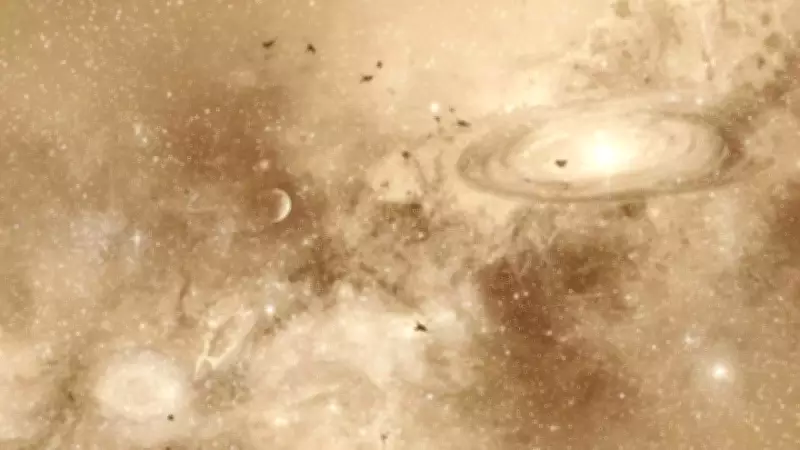
Instead of the expected black, the average color of the universe's light is a very light beige, a shade they affectionately named "cosmic latte." This discovery emerged from a detailed analysis of observations from hundreds of thousands of galaxies. By measuring all the visible light emitted by these galaxies and combining it into a unified "cosmic spectrum," scientists used standard color science methods to convert this spectrum into a single visual color. The result was a creamy off-white tone, representing a true average of all visible light in the universe, not the perspective from Earth.
How Astronomers Calculated the Universe's Average Color
In the early 2000s, astronomers Karl Glazebrook and Ivan Baldry spearheaded a project utilizing data from the 2dF Galaxy Redshift Survey, one of the largest sky surveys of visible galaxies at that time. This survey mapped light from over 200,000 galaxies, measuring brightness across different wavelengths. Rather than examining each galaxy individually, the team aggregated this information to create a single spectrum of visible light in the universe.

This cosmic spectrum encapsulates all light emitted by stars, gas, and other cosmic phenomena. After compiling it, researchers employed computer programs and globally recognized color-matching techniques to translate it into a human-perceivable color. The final shade is a light beige with the digital color code #FFF8E7, enabling its use in graphics and educational materials.
Why the Universe Isn't Black Despite Space's Dark Appearance
It may seem paradoxical to assign a color to the universe when space appears dark. This discrepancy stems from how color is defined and how human vision processes light. Most of the sky lacks direct visible light sources, making space look black, and photons from distant stars are too faint for unaided eyes. However, when scientists sum all visible light from every luminous object in the universe, darkness does not result.
The electromagnetic spectrum includes various light types, but only visible wavelengths are perceptible to humans. By combining visible light from stars of all ages and types, scientists derived a composite color. Cosmic latte's beige-white hue indicates a blend of light from young blue stars and older red or yellow stars. This average color has evolved over cosmic time, shifting from a dominance of massive blue stars in the early universe to a warmer tone as longer-lived red and yellow stars became prevalent.
The Science Behind the Name "Cosmic Latte"
After computing the average color, the research team conducted an informal poll to select a name. Playful suggestions included cappuccino cosmico, big bang beige, and skyvory. Cosmic latte emerged victorious, closely representing the creamy, pale color from the calculations. This term has captured public imagination, featured in NASA's Astronomy Picture of the Day, science outlets, and textbooks, making an abstract scientific concept more relatable through a familiar coffee reference.
What This Reveals About the Universe
The discovery of cosmic latte is not merely a curiosity; it provides valuable insights into how starlight distributes across the universe over time. The cosmic spectrum offers clues about:

- The ages and populations of stars
- The evolution of stellar light as massive stars fade and cooler stars take over
- Changes in the universe's overall light signature across billions of years
While cosmic latte does not alter how the universe appears from Earth, it illustrates star formation history and shifts in light composition. This finding demonstrates how astronomical data can offer fresh perspectives on cosmic questions, transforming a simple inquiry into a profound exploration of universal properties.