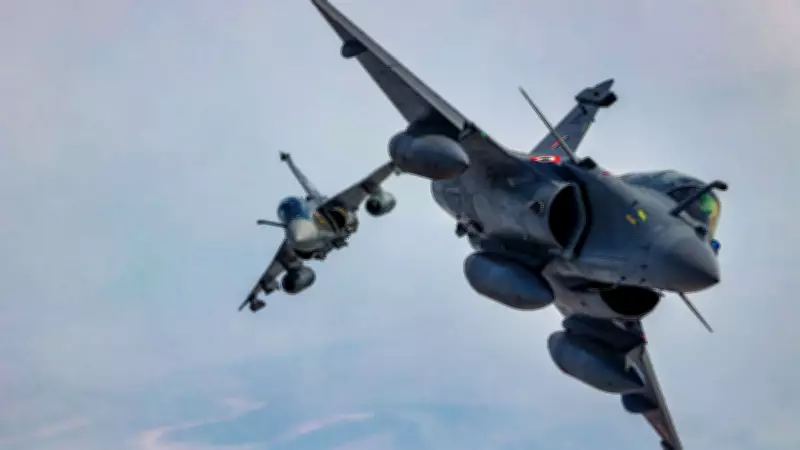
Air power is being redefined as India's armed forces synchronize to make unmanned systems the core of future warfare. Drones have taken center stage in modern conflicts, as demonstrated by the ongoing war in Ukraine and clashes in West Asia. The Indian defence establishment is increasingly expanding the scope and use of Unmanned Aerial Systems (UAS) as a central tool in any future conflict.
Operational Doctrines Reshaped
The armed forces are reshaping their operational doctrines and tactics to cater to the deployment of unmanned systems as well as counter-unmanned systems. A landmark demonstration occurred during Operation Sindoor in May last year, when India used unmanned systems to hit targets deep inside Pakistan and destroy critical elements of Pakistan's air defence architecture. Simultaneously, Pakistan's massive drone assault on India was neutralized by Indian defences.
Speaking at an event in New Delhi, Indian Air Force chief Air Chief Marshal AP Singh stated: "This topic of drones and Unmanned Aerial systems is very relevant. It is a reality. So, there is no denying that the battlefield has shifted. We are shifting from concentrated air power to a decentralised and autonomous way. We must understand that the Unmanned Aerial systems are extensions of air power. There is also reduced risk in terms of human life during the operation."

Operation Sindoor: A Turning Point
Operation Sindoor marked a turning point where unmanned systems were deployed as primary strike platforms under the nuclear overhang, signalling their arrival as decisive tools of combat. As the armed forces work to increase jointness among the three services, they are also improving coordination in the realm of unmanned systems.
Chief of Integrated Defence Staff (CISC), Air Marshal Ashutosh Dixit, emphasized the imperative of integration: "Forging tri-service synergy and integration in UAS and counter-UAS is not merely desirable but is a strategic imperative. No single service can fight the next war alone. Only collective leadership, integrated systems and shared situational awareness can deliver decisive victory. Unmanned Aerial Systems are no longer just enablers, they are a means of warfare in their own right. In the operation, drones became a weapon of choice for the first time in the Indo-Pak conflict. Drones are only the opening act of the coming robotic war."
Coordination and Counter-Systems
Air Chief Marshal Singh also stressed the importance of coordination: "When we talk about counter-UA systems, it is like a cat-and-mouse game. I think we have done reasonably well in Operation Sindoor, and it was possible because there was coordination. We will have all three services operating in the same airspace, then there has to be total coordination."
From the Army's perspective, Director General of Army Aviation, Lt Gen Vinod Nambiar, highlighted the industrial and strategic dimension: "At a time when the future of warfare is being reshaped by unmanned systems, the dialogue is not optional, but essential. The battle space of tomorrow will be defined by how effectively we harness unmanned systems and how resiliently we defend against them. UAVs now are multi-dimensional, supporting logistics, communication, electronic warfare, search and rescue, maritime patrol, and NBC (Nuclear, Biological & Chemical) defence."
New Doctrine for Unmanned Systems
India's defence establishment is converging on a new doctrine that places unmanned systems at a pivotal role in combat. The Air Force views UAS as extensions of air power, demanding both coordination across services and rapid development of counter-systems. Together, these perspectives underline that unmanned systems are not just reshaping tactics but redefining the very architecture of warfare.
Operation Sindoor served as the proving ground, but conflicts of the future will require deeper integration, indigenous innovation, and relentless adaptation in the evolving cat-and-mouse race of drone and counter-drone technologies.