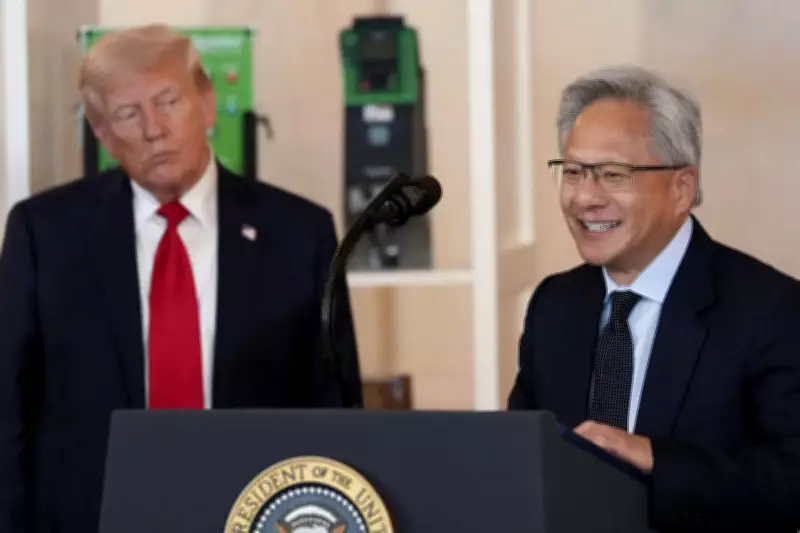
The United States has quietly granted approval to approximately 10 major Chinese companies to purchase Nvidia's second-most powerful artificial intelligence chip, the H200. However, not a single chip has been delivered yet, as the deals remain stalled due to Beijing's reluctance to allow its companies to acquire American technology. This development coincides with Nvidia CEO Jensen Huang, who was not originally part of the US delegation heading to Beijing, now accompanying President Donald Trump to meet Chinese President Xi Jinping. The surprise move has raised hopes that Huang's presence could help break the deadlock and finally facilitate the chip sales.
Which Chinese Companies Received Approval for H200 Chips?
Citing three people familiar with the matter, a report by Reuters revealed that the US Commerce Department has approved the following companies to purchase H200 chips: Alibaba, Tencent, ByteDance, JD.com, Lenovo, and Foxconn. Lenovo officially confirmed its approval to Reuters, stating it is “one of several companies approved to sell H200 in China as part of Nvidia's export license.” Under the terms of the US license, each approved buyer can purchase up to 75,000 chips, either directly from Nvidia or through approved distributors.
Why Haven't the Chips Been Shipped?
Despite the green light from Washington, the sales have gone nowhere because Beijing appears to be blocking the deals. Sources indicate that Chinese firms have pulled back after receiving guidance from the Chinese government. US Commerce Secretary Howard Lutnick supported this during a Senate hearing last month, stating that “the Chinese central government has not let them, as of yet, buy the chips, because they're trying to keep their investment focused on their own domestic industry.” China does not want its largest tech companies spending billions on American chips while it strives to build its own semiconductor industry.

China's Bet on Domestic Chips
Beijing's strategy is becoming increasingly clear. Rather than depending on Nvidia, China is pushing its tech industry to adopt homegrown chips, particularly those manufactured by Huawei. AI companies like DeepSeek have already highlighted their use of domestic chips. Speaking to Chinese state broadcaster CCTV, Huang expressed hope that the “good relationship” between Trump and Xi would help improve bilateral ties and potentially resolve the chip sales impasse.