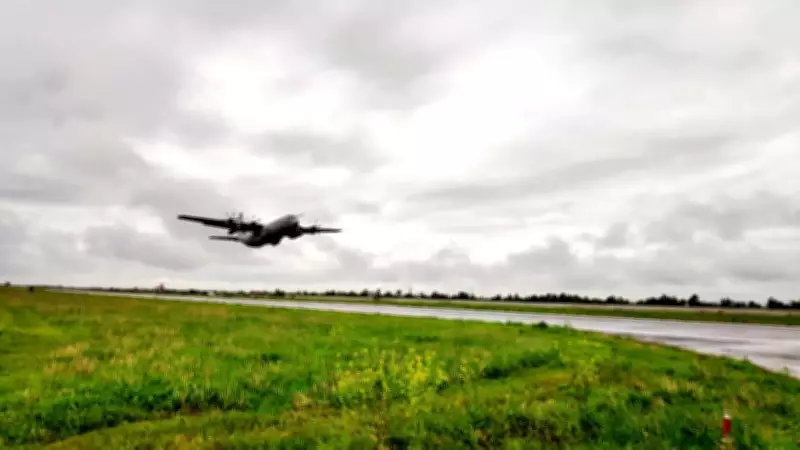
The United States Air Force (USAF) is developing advanced hard-kill systems to protect its large, slow-moving force multipliers, such as mid-air refuelers and Airborne Early Warning & Control (AEW&C) aircraft, from increasingly sophisticated long-range missiles. As the ranges of Air-to-Air Missiles (AAMs) and Surface-to-Air Missiles (SAMs) extend to hundreds of kilometers, these vulnerable platforms face growing threats from purpose-built weapons like the Russian R-37 and Chinese PL-17, which are designed to cripple opposing forces by targeting their support aircraft.
Vulnerability of Large Aircraft
Large aircraft, including AEW&C platforms, mid-air refuelers, and transport aircraft, operate slower and with far less maneuverability than fighter jets, making them easy targets for long-range missiles. Unlike modern fighters with low Radar Cross Sections (RCS), these aircraft have a large RCS, allowing them to be detected at greater distances. Air Marshal AK Bharti, former Director General of Air Operations during Operation Sindoor, highlighted that the Indian Air Force shot down a large Pakistani aircraft at a range of about 300 km, underscoring the threat.
Large Aircraft Survivability System (LASS)
To counter these threats, the USAF plans to invest more than $500 million by 2031 to develop the Large Aircraft Survivability System (LASS), an integrated protection suite for cargo and refueling aircraft. The fiscal 2027 budget requests $68 million for research, development, test, and evaluation of LASS, including $50 million for upward and downward scanning sensors and $18 million for an effector system combining processors with kinetic and non-kinetic weapons to autonomously defeat long-range threats. According to Air & Space Forces Magazine, modularity will allow LASS to deliver tailored protection packages for each airframe and mission. Autonomous defeat capabilities aim to reduce reliance on escort fighters and ground-based defenses, enhancing operational flexibility and survivability during contested logistics and aerial refueling operations.

Funding and Timeline
The requirements for LASS were validated in March under the Platform Agnostic Kinetic Self-Defense (PAKS-D) attributes document. The USAF projects $508 million across five years through 2031, with $264 million earmarked for the effector system in 2028–2029 and $176.2 million for sensors from 2028–2031. Initial contracting is expected to use Other Transaction Agreements to accelerate prototyping, though specific timelines remain unspecified. LASS is designed to complement, not replace, existing systems like the Large Aircraft Infrared Countermeasures (LAIRCM), as reported by Aviation Week.
The development of LASS marks a significant step in protecting critical assets that enable global power projection, ensuring that large aircraft can operate safely in contested environments.