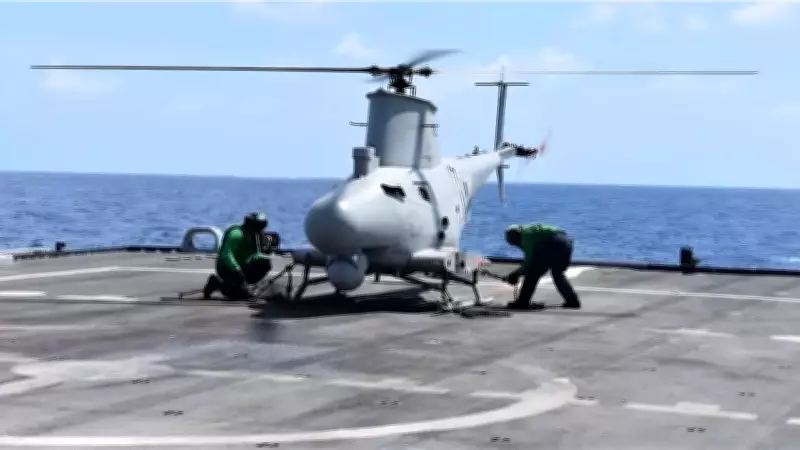
The White House has requested $54.6 billion for the newly established Defence Autonomous Warfare Group (DAWG), marking a 24,000 per cent increase within a single fiscal year. According to former CIA Director David Petraeus, DAWG represents the "largest single commitment to autonomous warfare in history."
Background and Initiatives
In January, the Pentagon's Defence Innovation Unit (DIU), in partnership with DAWG, announced a challenge offering up to $100 million to develop an 'Autonomous Vehicle Orchestrator'. The system would allow a single soldier, without specialised training, to command an entire group of unmanned vehicles simultaneously through voice or text instructions.
Global Drone Usage in Conflicts
Countries worldwide have increasingly relied on drones in warfare. During the ongoing US-Iran conflict, Iran deployed swarms of Shahed-136 drones against US bases, Israeli targets and Gulf states. In the four-year Russia-Ukraine war, Russia increased its drone usage tenfold between early 2024 and mid-2025, extensively deploying Iranian Shahed-136 drones, rebranded as Geran-2, armed with 80kg warheads. Russia also launched large-scale FPV drone campaigns against both military and civilian targets in Ukraine.

Ukraine, facing a numerically superior adversary, has emerged as a leading innovator in drone warfare. The country now produces millions of drones annually and employs sea drones, ground drones and FPV systems, which are estimated to account for around 80 per cent of battlefield casualties.
India's Drone Expansion
India has also steadily expanded the use of drones in military operations. During Operation Sindoor, India reportedly deployed indigenous platforms including the Rustom-2 medium-altitude long-endurance (MALE) UAV, Searcher II reconnaissance drones and FPV kamikaze drones for precision strikes on Pakistani air bases and counter-terrorism operations.
US Defence Budget and Cost Challenges
The United States has proposed a defence budget of $1.5 trillion for FY27, roughly three times Iran's GDP according to World Bank estimates for 2024. Yet despite commanding nearly 40 per cent of global military spending, maintaining a vast overseas military presence, operating aircraft carriers and fielding advanced stealth aircraft and missile systems, Washington continues to struggle with the costs of modern warfare.
According to the Council on Foreign Relations, using air defence systems to intercept drones can cost between five and one hundred times more than the drones themselves. A Patriot interceptor missile costs approximately $4 million, compared with roughly $35,000 for a Shahed-136 drone. "Defeating a $500 drone with a $3M missile may be effective, but not sustainable. As quantity matters, the more drones a state can produce, the more sustainable its drone operations and the more credible its threat to stay the course," the Australian Army Research Centre noted in a report.
Previous US Efforts: Replicator Programme
The US attempted to address this challenge in 2023 through the Replicator programme, which aimed to deploy large numbers of drones. However, the initiative encountered hardware limitations and supply chain bottlenecks and was eventually folded into the newly established DAWG programme in 2025.
Shift in Warfare Dynamics
With the rise of autonomous warfare, technological superiority alone no longer appears decisive. Increasingly, scalability, affordability and production capacity are becoming the determining factors. Programmes such as DAWG suggest that the United States is beginning to recognise this shift. Its success, however, will depend on the lessons learned from modern battlefields and the shortcomings of its predecessor.