

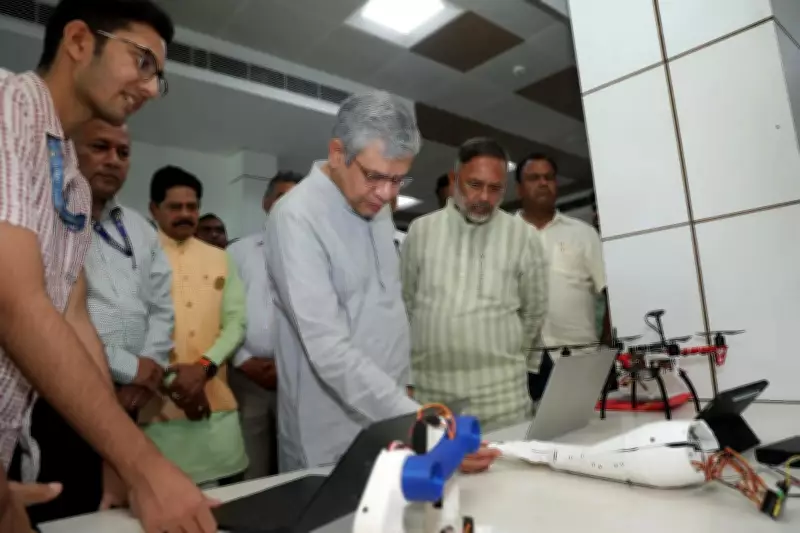
Union Electronics and IT Minister Ashwini Vaishnaw inaugurated a Makers Lab at the Malaviya National Institute of Technology (MNIT) in Jaipur on Thursday. During the event, he called upon students to develop Rajasthan's first semiconductor chip, signaling the state's ambition to join India's strategic chip-making drive.
Makers Lab to Provide Hands-On Training
Officials stated that the Makers Lab will offer students experiential and hands-on training opportunities in both software and hardware technologies. This includes sensors, embedded systems, compute devices, and electronics systems.
Advanced Labs Announced
Vaishnaw announced plans to establish an Advanced Quantum Computing and Quantum Communications Lab, as well as an AI lab at MNIT. These initiatives position the institute as a new hub for advanced technology and talent development. The Quantum Lab will be set up under the Electronics and ICT Academic Project of the Ministry of Electronics and Information Technology (MeitY).

Quantum Technology as the Next Wave
Addressing students and faculty, Vaishnaw emphasized that while the current technological wave is driven by AI, the next major wave will be led by Quantum Technology. He stated, "The work to be undertaken under this project will be significant for the country. The lab will also undertake research in Quantum Key Distribution (QKD), which is important from the national security perspective. MNIT Jaipur must take a leadership role in the area of post-quantum cryptography."
Access to Semiverse Platform
The minister also announced that MNIT Jaipur students will gain access to Lam Research's "Semiverse" platform, a digital twin-based semiconductor fabrication and training ecosystem. Through Semiverse, students can study semiconductor chip structures in 3D, understand chip manufacturing processes, and simulate fabrication steps in a virtual environment.
Encouraging Students to Meet Workforce Demand
Encouraging students, Vaishnaw noted that industry estimates indicate a demand for over one million semiconductor design professionals. He expressed confidence that India can bridge this gap with the young generation joining the workforce. He added that the Government of India, as part of the Chips to Startup (C2S) Programme, is providing Electronic Design Automation (EDA) tools to more than 323 universities across the country.






