

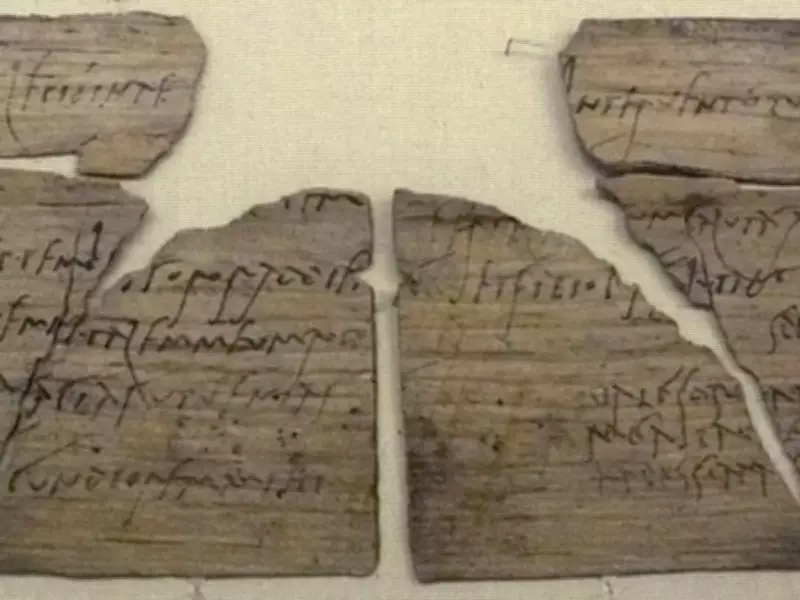
In 1973, during excavations at the site of a Roman military base called Vindolanda in northern England, archaeologists noticed something easily overlooked: a thin piece of wood that appeared to be ordinary trash. However, this fragment was actually an extremely fragile wooden leaf-tablet used for ink writing. This discovery dramatically shifted scholars' perception of daily life in the Roman Empire. Before it, history consisted of weapons, stone walls, and magnificent buildings. These wooden tablets provided insights into the daily lives of ordinary people through written records that preserved their voices.
A Piece of Trash That Was Not Trash
The first Vindolanda ink tablets were discovered during excavation work in 1973. Initially, the artifacts appeared as thin, dark fragments of wood, easy to confuse with regular rubbish. Their uniqueness lay in the traces of ink left on them. According to a study described in the Journal of Analytical Methods in Chemistry, these modest discoveries shed light on the habits and personal lives of common people, making them more appealing to an audience. A simple change of perspective transformed a thin piece of wood that could have been discarded into part of an unusual archaeological archive. This proved that archaeology depends heavily on observation, as not all findings require large-scale excavation.
Why the Wood Survived
Thin wooden pieces are typically vulnerable and deteriorate easily in soil. The secret behind the longevity of these artifacts is their specific burial site. According to research published in Scientific Reports, waterlogged soil deprived of oxygen helped preserve the wood pieces with the written text. This outstanding conservation inspires admiration for nature. The environment provided a unique long-term habitat for these daily-use items. The tablets survived due to a combination of factors: selecting proper wood, burying it in a damp environment, and discovering it at the right moment centuries later. The environment determines our knowledge of the ancient world.

A Fort Packed with Daily Lives
Located in northern England, just south of Hadrian's Wall, Vindolanda was a Roman auxiliary fort and settlement. However, it was not simply an outpost filled with soldiers and harsh living conditions. According to modern studies, it can be described as a bustling center populated with women, children, laborers, and traders. The tablets provide a perfect example of artifacts that convey this aspect of the past to the audience. The value of the letters stems from their combination of duty to the state and personal lives. While it might be difficult to see how any fort could be anything but rigidly disciplined, the writing reveals a real world where individuals coordinated resource movement, prepared for journeys, dealt with illnesses, and stayed in touch with relatives.
Topics Covered in the Letters
According to scholarly analysis, the texts encompass a vast array of topics. From official military administrative lists to private correspondence, the wooden documents give a broad overview of daily activities within the fort. Everyday routine is placed next to more serious issues, making them a valuable source. Claudia Severa invited her friend Sulpicia Lepidina to her birthday celebration, reminding us that regular people lived in the fort. This informality is especially valuable to historians as it shows human behavior.
Faint Ink Written on Fragile Wood
The texts on the tablets were not immediately deciphered. To make them visible, extensive conservation work was required, including cleaning. Due to the delicate condition of the wood, scientists used infrared imaging and other techniques to conduct comprehensive surface analysis. This allowed them to identify the composition of the black inks and significantly increase the legibility of the damaged text, demonstrating the importance of using science in archaeology. In conclusion, the work of interpretation begins much later than the discovery of the artifact itself, and appropriate tools are essential to preserve the integrity of the object under study.






