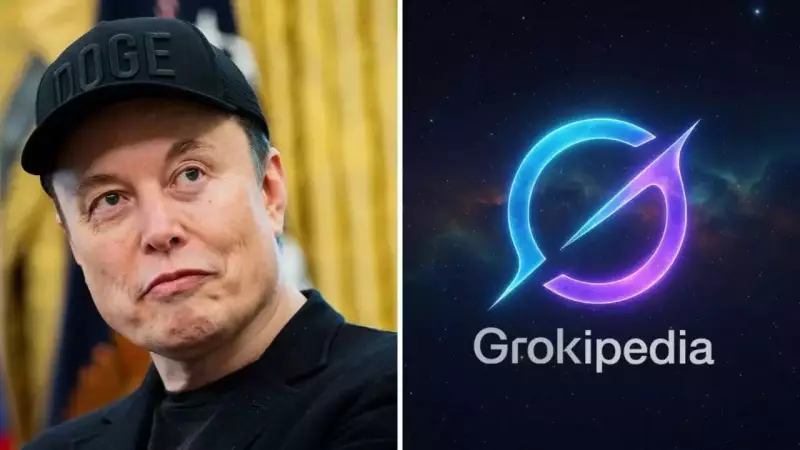
Jimmy Wales, the co-founder of Wikipedia, has raised serious concerns about the viability and trustworthiness of Elon Musk's new artificial intelligence-driven encyclopedia, Grokipedia. In a recent interview, Wales expressed skepticism about the platform's ability to produce reliable content, pointing to fundamental flaws in its AI-based approach.
AI Hallucinations and Accuracy Concerns
Wales highlighted the core technical problem plaguing large language models (LLMs) like the Grok chatbot from Musk's xAI, which powers Grokipedia. He identified "hallucinations" as a major hurdle. This term refers to the AI's tendency to generate information that sounds plausible but is factually incorrect. Wales, who stated he frequently uses LLMs himself, emphasized that this makes them unsuitable for the meticulous task of encyclopedia creation. "Large language models really aren't good enough to write an encyclopedia," he told The Verge.
Beyond technical inaccuracies, Wales questioned the public's willingness to trust a knowledge platform controlled by Elon Musk. Musk launched Grokipedia in October 2023, partly motivated by his long-standing claim that Wikipedia suffers from a left-wing bias. Wales countered this by suggesting that an encyclopedia perceived to have "a thumb on the scales" would struggle to gain credibility. He admitted to only briefly reviewing Grokipedia but was unsurprised by the negative feedback it has received since its debut.

Contrasting Philosophies: Wikipedia vs. Grokipedia
Wales drew a clear distinction between his collaborative approach and Musk's top-down style. He explained that on Wikipedia, disagreements are resolved through community discussion and consensus. In contrast, he implied that Musk would likely unilaterally change content he disagreed with on Grokipedia. This aligns with Musk's known hands-on management style, exemplified by reports that after acquiring Twitter (now X), he instructed engineers to boost the visibility of his own posts.
Interestingly, while Wikipedia aims to retain its users, it permits AI bots to scrape its content. This has led to instances where Grokipedia entries are nearly identical to Wikipedia's. However, significant political divergences have been noted. A Business Insider report found that Grokipedia's content on sensitive topics like the January 6 Capitol Riots and the 2014 Gamergate controversy appears to align more closely with Musk's political views. "It's Elon, but that might not be what we all want from an encyclopedia," Wales remarked.
Growth Amidst Controversy and Historical Bias Claims
The debate over bias is not new for Wikipedia. Its other co-founder, Larry Sanger, left the project in 2002 and has since repeatedly accused it of being "badly biased" and dominated by liberal viewpoints. Wales, in a previous conversation, acknowledged Sanger's contributions but questioned the "co-founder" title for his role.
Despite the criticism, Grokipedia is expanding. Musk has grand ambitions for the project, calling it the "modern-day Library of Alexandria" and even expressing a desire to send it into deep space. The platform has progressed from version "v0.1" to "v0.2," and its article count has grown from 885,279 at launch to over 1,089,057 by November. For context, Wikipedia hosts more than 7 million articles.
The emergence of Grokipedia represents a significant challenge to the traditional model of crowd-sourced knowledge, but as Jimmy Wales argues, it must first overcome fundamental issues of AI reliability and perceived impartiality to be taken seriously as a credible source of information.