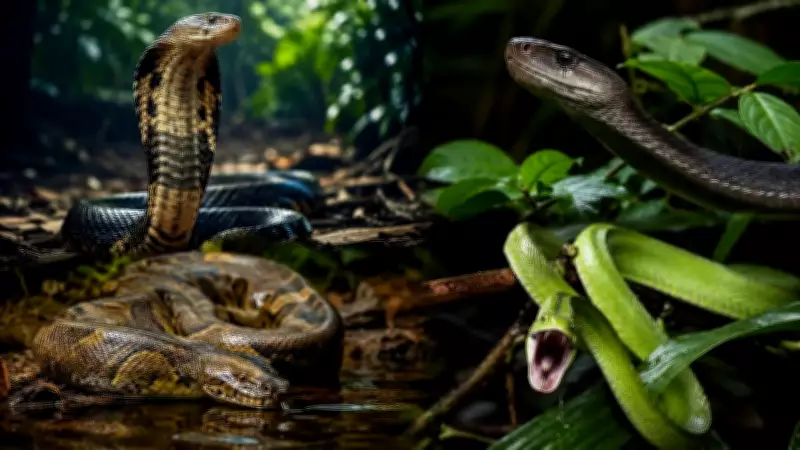
Snakes have long unsettled people with their silent movements, sudden strikes, and seemingly calculated behavior. While scientists generally avoid labeling snakes as “smart” in the human sense due to their instinct-driven actions, several species exhibit hunting and defense tactics so unusual they appear almost planned. Some snakes lure prey by imitating other animals; others feign death when threatened. The king cobra, often considered the most intelligent snake, reportedly adapts its hunting strategy based on its prey. According to Discover Wildlife, evolution has shaped certain snakes into surprisingly cunning predators.
World’s Smartest Snakes and Clever Hunting Tricks
King Cobra
The king cobra is renowned for its size and venom, but its behavior truly sets it apart. As the longest venomous snake, it can exceed five meters in length. Unlike most snakes that follow repetitive hunting patterns, the king cobra displays flexibility, approaching different prey in different ways, especially when hunting other snakes. It also exhibits unusual parental care: female king cobras build nests for their eggs, gathering leaves and debris, laying eggs inside, and guarding them. This rare reptilian behavior suggests heightened awareness.
Tentacled Snake
The tentacled snake, found in Southeast Asia, appears unassuming with its small, thin body and strange tentacles near its nose that sense underwater movement. Its hunting technique is remarkable: it remains still until fish approach, then performs a deceptive maneuver. Instead of striking directly, it makes a slight movement, triggering the fish’s escape reflex. The fish darts in a predictable direction—straight into the snake’s mouth. This sequence occurs in under 30 milliseconds.

Eastern Hognose Snake
The eastern hognose snake is mildly venomous but poses little danger to humans. When threatened, it first displays intimidation: hissing, flattening its neck, and bluff-striking with a closed mouth. If that fails, it performs a dramatic death-feigning act, rolling onto its back, opening its mouth, and letting its tongue hang limp. One observed snake remained motionless for 45 minutes before flipping over and slithering away.
Spider-tailed Horned Viper
The spider-tailed horned viper has a tail that resembles a spider, with a bulb-like structure and leg-like scales. It hides in rocky deserts and wiggles its tail to attract birds and reptiles. When prey approaches for an easy meal, the viper strikes with extraordinary speed.
Black Mamba
The black mamba is feared for its speed and highly toxic venom, which attacks the nervous system and can cause respiratory failure. Recent studies reveal its venom may have a complex dual action: some toxins block nerve-muscle communication, causing paralysis, while others overstimulate nerves. This combination can lead to paralysis followed by severe muscle spasms during antivenom treatment. Researchers are studying how these effects evolved together.