

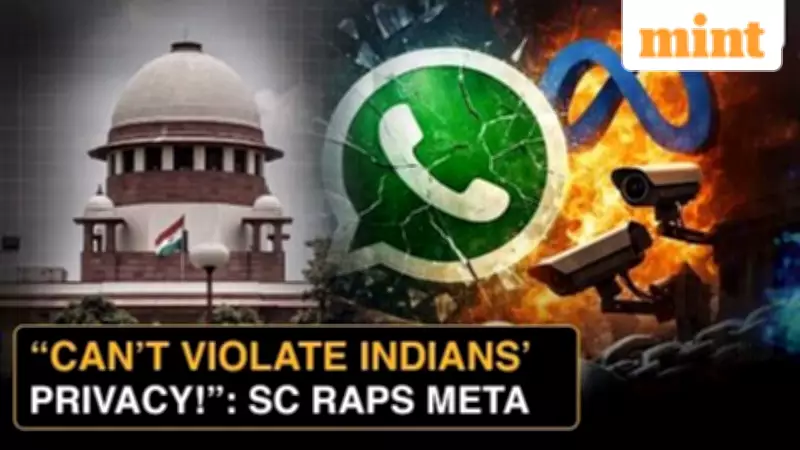
Supreme Court Issues Stern Warning to WhatsApp Over Controversial Privacy Policy
In a landmark hearing that could reshape digital privacy norms in India, the Supreme Court has delivered a scathing rebuke to WhatsApp and its parent company Meta over their contentious "take it or leave it" privacy policy. The apex court unequivocally declared that privacy is a fundamental right for Indian citizens, not an optional feature that tech giants can manipulate at will.
"A Decent Way of Committing Theft"
The justices did not mince words when characterizing WhatsApp's 2021 privacy policy update, which forced users to accept new terms or lose access to the platform. The court described this approach as "a decent way of committing theft of private information" – a powerful indictment that underscores the gravity of the situation. This strong language reflects the judiciary's growing concern about how major technology companies handle user data in the digital age.
Consent Must Be Meaningful and Understandable
A central point in the court's criticism focused on the nature of consent under WhatsApp's policy framework. The justices emphasized that consent cannot be considered genuine or informed when terms and conditions are so complex that ordinary users cannot reasonably comprehend them. This principle strikes at the heart of many digital platforms' user agreements, which often run to thousands of words filled with legal jargon that few people actually read or understand.

Building on Regulatory Precedents
The Supreme Court's stance builds upon earlier rulings from regulatory bodies that have examined WhatsApp's practices. The Competition Commission of India (CCI) and the National Company Law Appellate Tribunal (NCLAT) previously found that WhatsApp had abused its dominant market position by forcing users to share data with Facebook (now Meta). These bodies upheld a substantial penalty of ₹213 crore against the company for anti-competitive behavior related to data sharing practices.
Constitutional Ultimatum and Next Steps
In perhaps the most dramatic moment of the proceedings, the Supreme Court issued what amounts to a constitutional ultimatum to the tech giant: "If you can't follow the Constitution, leave India." This stark warning underscores the seriousness with which the court views potential violations of fundamental rights in the digital sphere.
The court has taken several concrete actions to move the case forward:
- Added the Ministry of Electronics and Information Technology (MeitY) as a formal party to the proceedings
- Scheduled interim orders for February 9, 2026
- Indicated that further hearings will examine whether WhatsApp's practices violate constitutional protections
This development represents a significant escalation in the ongoing battle between Indian regulators and global technology companies over data privacy standards. The Supreme Court's intervention suggests that previous regulatory actions and penalties may have been insufficient to curb practices that the judiciary now views as potentially unconstitutional.
The case continues to evolve as India seeks to establish clearer boundaries for digital privacy in an era dominated by platforms that collect vast amounts of personal information. The outcome could set important precedents not just for WhatsApp and Meta, but for the entire technology sector operating in the world's largest democracy.

