The Detection of Crime Branch in Surat made a major breakthrough this week. They dismantled an international cybercrime network involved in laundering more than Rs 2,000 crore. This huge sum was siphoned off through various sophisticated digital frauds.
Arrests and Account Details
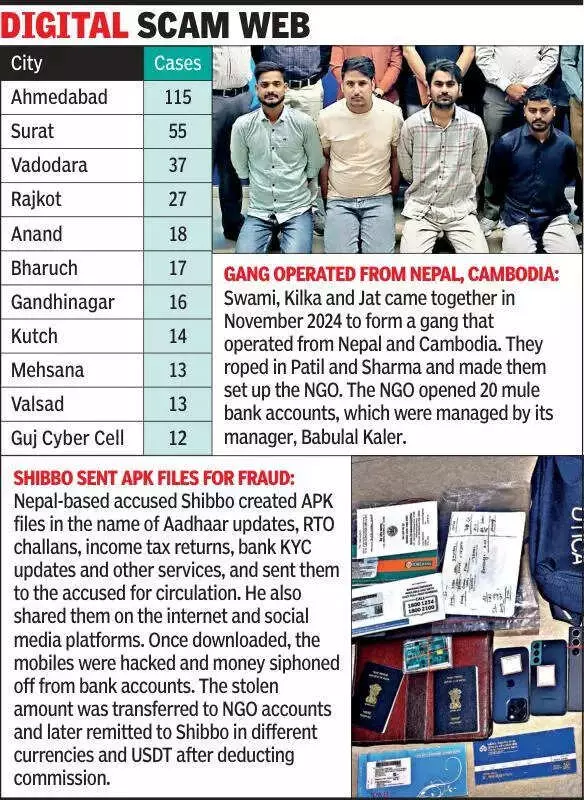
Police officers arrested four key individuals in connection with the racket. They successfully traced details of 44 mule accounts used to deposit the fraudulent money. These specific accounts have attracted a staggering 6,040 complaints on the National Cyber Crime Reporting Portal. Out of these, 482 complaints originated from Gujarat alone.
The Tip-Off and Initial Arrests
Authorities received confidential information about Mukesh Swami and Babulal Kaler. The duo was allegedly running the illegal operation under the guise of Savariya Creations. This is a textile firm located in Surat's Global Textile Market. Inspector S N Parmar and Sub-Inspector Kirtipalsinh Puwar led the investigation. They cracked the case and apprehended the two men from the Vesu area.

Complex Web of Illicit Finance
Preliminary investigations uncovered a complex method. The accused used a network of NGOs, fintech companies, credit societies, and shell firms to park the illicit funds. Police have identified several firms linked to this massive scam. These include Avya Homes International, Gyaneshwari Organics Pvt Ltd, Kimistu IT Solutions, and Painganga Urban Co-operative Credit Society Ltd.
Official Statement on the Scale
Deputy Commissioner of Police Bhavesh Rojiya provided details to the press. "During our investigation, we obtained details of 44 mule accounts," he stated. "Checking these on the NCCRP portal revealed 6,040 complaints from across India. We have verified 940 complaints so far and confirmed a fraud of Rs 750 crore. We firmly believe the total amount involved will exceed Rs 2,000 crore."
Further Arrests and Network Expansion
The arrested individuals revealed more details. Proceeds from the cybercrimes were funneled into accounts of an NGO named Vidhya Pradhan Dharma Foundation. Consequently, its directors, Mitesh Patil and Ashish Sharma, were also taken into custody. While Swami and Kaler hail from Sujangarh block in Rajasthan's Churu district, Patil is from Dhulia in Maharashtra. Sharma comes from Jaunpur district in Uttar Pradesh.
Police have also filed charges against four more accused. This list includes Rajasthan natives Dinesh Kilka (Jat) and Anil Prajapati. It also names a Nepal citizen known as Shibbo and an unidentified Cambodian national. Investigators believe all these individuals are masterminds behind the extensive racket.
International Connections and Methods
The investigation revealed significant international travel. Mukesh Swami visited Cambodia three times. He also traveled to Thailand and Dubai twice. These trips were to meet with Chinese gang members. Swami had special pay-out facilities on his bank accounts. These allowed him a daily transaction limit of up to Rs 5 crore. This facility enabled the swift transfer of fraud money to other accounts. His personal cryptocurrency account showed transactions worth $83,448 since March 2025.
Formation and Operation of the Gang
The gang's formation dates back to November 2024. Swami, Kilka, and Jat came together to form a criminal syndicate. They operated primarily from Nepal and Cambodia. The trio later roped in Patil and Sharma. They instructed them to set up the NGO. This NGO subsequently opened 20 mule bank accounts. Babulal Kaler managed these accounts as the NGO's manager.
Role of APK Files in the Fraud
The accused Shibbo played a crucial technical role. He created malicious APK files. These files were disguised as legitimate applications for Aadhaar updates, RTO challans, income tax returns, and bank KYC updates. He sent these files to the other accused for circulation. The files were also shared widely on the internet and social media platforms.
Once an unsuspecting user downloaded the file, their mobile device was hacked. Money was then siphoned directly from their bank accounts. The stolen funds were transferred to the NGO accounts. From there, the money was remitted to Shibbo in various currencies and USDT, after deducting a commission.

Internal Disputes and Shift in Operations
Internal conflicts arose within the gang. After some NGO accounts were frozen, Swami and Kilka quarreled over commission payments and other issues. This dispute led Swami to leave the "Nepal line" of operation. He then started a new "Cambodia line." To continue the fraud, he opened a fintech company and a credit society to park the illicit money.