

Rajya Sabha MP Calls for India to Lead Global Technology Innovation
Rajya Sabha member Sudhanshu Trivedi delivered a compelling address to students and faculty at the AXIS festival of Visvesvaraya National Institute of Technology (VNIT) in Nagpur on Friday. He emphasized that India must transition from merely adopting technology to spearheading global innovations, positioning the nation as a frontrunner in the digital era.
Digital Payment Dominance Highlighted
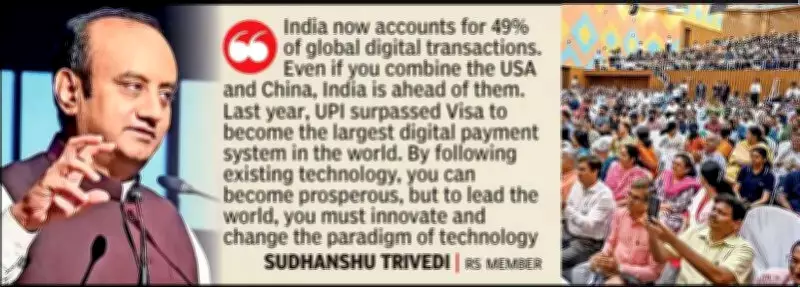
Trivedi pointed to India's remarkable achievements in digital payments as evidence of its technological prowess. He revealed that India now accounts for an impressive 49% of all global digital transactions. "Even if you combine the digital transaction volumes of the United States and China, India still surpasses them," he stated confidently.
The parliamentarian highlighted that the Unified Payments Interface (UPI) achieved a significant milestone last year by overtaking Visa to become the world's largest digital payment system. He cited international recognition of this success, noting that Japan's Prime Minister made a digital payment during a visit to a Delhi market, while French President Emmanuel Macron completed a transaction at a roadside tea stall in Jaipur. "Countries from whom we once learned are now astonished by India's rapid transformation," Trivedi remarked.

Infrastructure and Accessibility Advances
Trivedi identified the dramatic reduction in data costs as a crucial factor driving digital inclusion across India. "Approximately 10-12 years ago, 1 GB of data cost over Rs300 per month. Today, that same amount of data is available for around Rs28 per month," he explained, illustrating how affordability has expanded access.
He also highlighted advancements in academic research accessibility, revealing that over 6,300 institutions across India now have access to global research journals through a national portal. In 2025 alone, more than 11 crore research papers were downloaded through this system, demonstrating widespread utilization.
Future Technological Investments
Looking ahead, Trivedi outlined substantial government investments in emerging technologies. He pointed to a Rs30,000 crore allocation for artificial intelligence development and Rs6,000 crore dedicated to quantum technologies. Additionally, he mentioned national missions focused on green hydrogen and renewable energy as part of India's comprehensive technological strategy.
The MP urged students to think beyond replication and imitation. "By following existing technology, you can achieve prosperity, but to truly lead the world, you must innovate and change the paradigm of technology itself," he advised, encouraging original thinking and breakthrough developments.
Broader Context and Observations
Trivedi connected Nagpur's geographical position as India's center point with its historical role as a hub of nationalist thought. He also shared observations on global demographic shifts, particularly in Europe. "European nations are facing potential demographic challenges due to increasing Muslim immigrant populations," he noted, explaining that approximately 25% of the population under 20 years old in some European countries is Muslim, primarily from Syria and other Arab nations.
He suggested these demographic changes might impact future military recruitment in European countries, where native populations may not provide sufficient personnel for armed forces. This broader context underscored his message about India's opportunity to assert global leadership through technological innovation and strategic planning.






