Namo Bharat Rapid Rail: A Seven-Year Engineering Triumph Transforms NCR Connectivity
When construction commenced on the Namo Bharat rapid rail in June 2019, the vision was ambitious yet straightforward: to shrink the sprawling daily commute between Delhi and Meerut into a swift, one-hour journey. What unfolded over the subsequent seven years was nothing short of a construction marathon, pushing technical boundaries and navigating some of the National Capital Region's most densely packed urban landscapes. The result is a seamless rail link that now stitches together Delhi, Ghaziabad, and Meerut, marking a monumental achievement in Indian infrastructure.
"This project presented civil, engineering, and logistical challenges on a scale we had never before encountered," revealed an official from the National Capital Region Transport Corporation (NCRTC). "Unlike metro systems or the Vande Bharat trains, this corridor required building almost entirely from the ground up. The COVID-19 pandemic inevitably slowed progress, but commissioning the full line on February 22 stands as a moment of immense pride and accomplishment."
The Yamuna Crossing: Delhi's Longest Rail Bridge
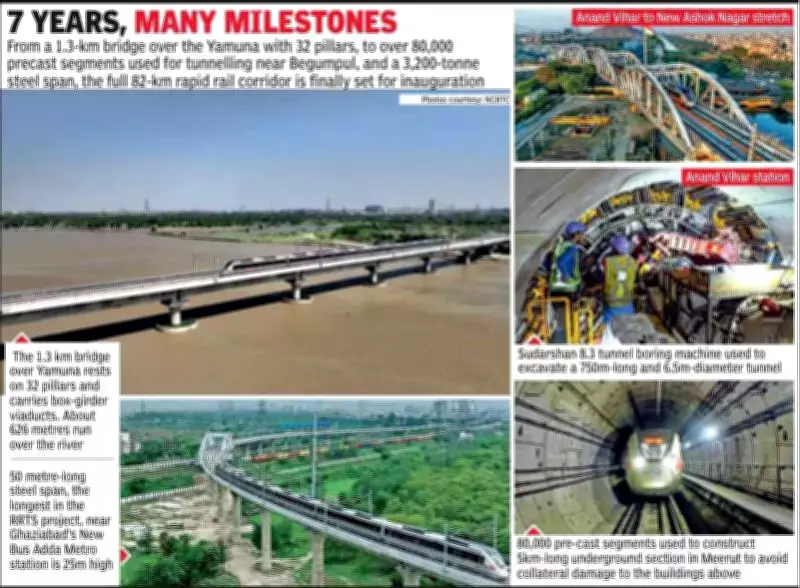
Among the project's most formidable obstacles was the construction of the Yamuna crossing, now Delhi's longest rail bridge. This 1.3-kilometer structure rests on 32 robust pillars and carries box-girder viaducts that were launched sequentially using heavy gantries. Approximately 626 meters of the bridge span directly over the river, with the remaining sections extending across floodplains on both banks.

"Each pier, particularly those positioned midstream, pushed our expertise to its absolute limits," the NCRTC official elaborated. "The monsoon seasons and elevated water levels over the last two to three years introduced an additional layer of complexity." Further complications arose during foundation laying, where a clay layer 10 to 15 meters below ground hindered piling operations. The shifting sand conditions demanded continuous monitoring and real-time adjustments to guarantee structural stability.
Work on the Yamuna floodplains was severely constrained, with water well construction feasible for only about seven months annually. To overcome these limitations, engineers employed advanced Building Information Modelling (BIM) to create a detailed 3D model of the entire bridge. This innovative approach enabled early problem detection, enhanced coordination among teams, and streamlined execution, allowing the monumental structure to be completed in a remarkable 2.5 years.
Running parallel to the DND Flyway, the bridge elegantly connects the Namo Bharat stations at Sarai Kale Khan and New Ashok Nagar. It skillfully navigates past the Barapullah flyover and Ring Road before seamlessly integrating into Sarai Kale Khan, threading through some of Delhi's most congested arterial routes.
Precision Underground: The Meerut Subterranean Challenge
If the Yamuna bridge exemplifies the corridor's grand scale above ground, the underground works in Meerut showcase its meticulous precision below the surface. A 5-kilometer subterranean section passes beneath the city's tightly packed, historic neighborhoods, housing the Meerut Central, Bhainsali, and Begumpul stations.
Begumpul station stands out as a particular engineering feat. Measuring 246 meters in length, 24.5 meters in width, and sunk approximately 22 meters below street level, its construction required exceptional care.
"Meerut is a congested, ancient city. Working at such depths while ensuring zero structural damage to the buildings overhead was a challenge that demanded absolute precision," the official emphasized. Located beneath a vibrant, bustling market, Begumpul is anticipated to attract significant foot traffic. It also serves as the corridor's most crucial interchange, uniquely offering both Namo Bharat and metro services within the same infrastructure—a pioneering first for India.

Meerut Central and Bhainsali stations will function exclusively as metro stops. The broader Meerut Metro network spans 23 kilometers, with 18 kilometers elevated and 5 kilometers underground across 13 stations. Although only three stations are subterranean, their construction consumed over 80,000 pre-cast tunnel segments. This method was crucial to minimize vibrations and protect surface structures, effectively reducing potential collateral damage.
Engineering Ingenuity Near Ghaziabad
On the priority section near Ghaziabad, engineers executed another impressive maneuver. They installed the corridor's longest steel span—a massive structure 15 meters wide and weighing 3,200 tonnes. This component was hoisted to a height of about 25 meters while the Delhi Metro's Red Line continued its uninterrupted operations directly beneath it near the tri-junction, demonstrating remarkable planning and execution.
The completion of the Namo Bharat rapid rail corridor is more than just a transportation link; it is a testament to seven years of relentless innovation, problem-solving, and dedication. It has redefined connectivity in the National Capital Region, setting a new benchmark for large-scale infrastructure projects in India.