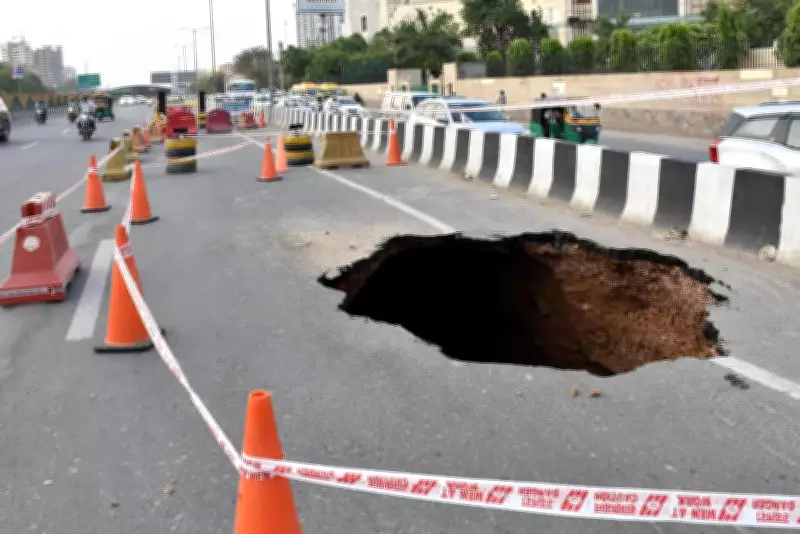
Gurgaon: A portion of Sohna Highway caved in on Wednesday, marking the sixth such incident since 2023. The cave-in created a pit approximately 10 feet wide and 20 feet deep, located just metres away from a similar collapse that occurred in June last year. After securing the affected area with barricades, NHAI officials stated that further action would be taken in coordination with the Gurugram Metropolitan Development Authority (GMDA).
Recurring Cave-Ins Linked to Damaged Sewer Line
Recurring cave-ins on this stretch have been attributed to a 1,800mm damaged master sewer line running beneath the highway. Although the sewer network was officially handed over to GMDA in 2022, the master pipeline has not undergone full rehabilitation. A rehabilitation plan using cured-in-place pipe (CIPP) technology was first proposed in 2017 by HUDA (now Haryana Shehri Vikas Pradhikaran) at an estimated cost of Rs 28.75 crore. The plan also included laying a 900mm line from Subhash Chowk towards Sector 48 and strengthening manholes. NHAI was responsible for executing the work under HUDA's supervision.
Project Scaled Down, Main Pipeline Ignored
However, during road widening and the administrative transition from HUDA to GMDA, the project was scaled down to only strengthening manholes, a task NHAI claims to have completed. Meanwhile, rehabilitation of the main pipeline remained unaddressed. Since December 2023, multiple sinkholes have emerged along this corridor, exposing the fragility of the sewer infrastructure. Incidents were reported in December 2023, July 2024, and May 2025, including a 12-foot-deep pit near Sispal Vihar caused by a collapsed sewer line and chamber. On June 30 last year, another sinkhole—about two metres wide and six metres deep—appeared on the same stretch. A smaller cave-in on June 18 also forced authorities to shut nearly one-and-a-half lanes as a precaution.

Blame-Shifting and Delayed Action
After prolonged blame-shifting between agencies, it was eventually decided that NHAI would undertake full rehabilitation of the sewer line using CIPP technology at a cost of Rs 68 crore. However, the work is yet to start. “We are getting it approved internally,” a senior NHAI official said. Despite frequent cave-ins and assurances of repair work, the lack of execution has made residents question the risks they face while commuting on this key arterial road, especially during the monsoon season.
Residents Voice Concerns
“It has become extremely risky for commuters to use this stretch, especially since the elevated section caters to heavy traffic movement. The repair work carried out in the past clearly hasn’t solved the problem. In fact, the damage seems to be getting worse with each incident. We are worried that if this continues, it could lead to a major accident. Fortunately, no one was hurt this time, but it easily could have been a serious tragedy,” said Vijay Shiv Nath, chairman of the Malibu RWA Federation.
The situation remains critical as the monsoon approaches, with residents demanding immediate action to prevent a potential disaster.