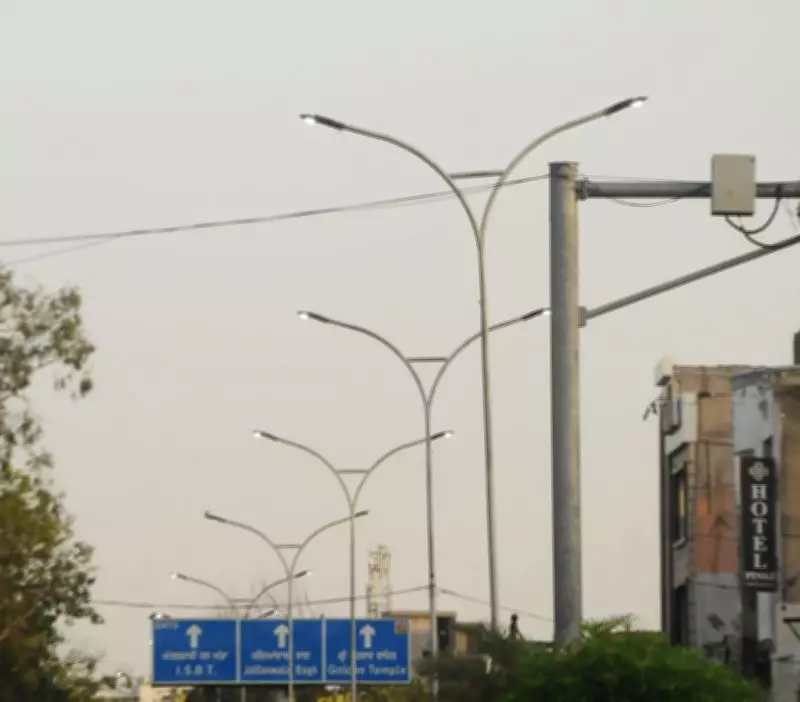
The city of Amritsar is witnessing significant power wastage as street lights continue to operate on winter timings, despite the onset of longer days. This has raised concerns among residents and environmentalists, who argue that the outdated schedule is leading to unnecessary electricity consumption and financial losses.
Current Situation
According to sources, the street lights in various parts of the city are programmed to turn on at 5:30 PM and switch off at 7:30 AM, following the winter schedule. However, with the sun rising earlier and setting later, the lights remain on for several extra hours during daylight, wasting thousands of units of electricity daily.
Residents have reported that in many areas, lights are still glowing well after sunrise, sometimes until 8:00 AM, and turn on before sunset, as early as 5:00 PM. This not only adds to the municipal corporation's electricity bills but also contributes to carbon emissions.

Residents' Concerns
Local activist Ravi Sharma said, "It is absurd that the authorities have not updated the timers. We see lights on even at 8 AM in bright sunlight. This is a clear case of negligence and waste of public money." Another resident, Simran Kaur, added, "The corporation should install automatic sensors that adjust based on daylight, rather than relying on fixed timings."
Expert Opinions
Energy experts suggest that the municipal corporation should adopt smart lighting systems with photocells that automatically turn lights on and off based on ambient light. This would not only save energy but also reduce maintenance costs. Dr. Anil Gupta, a professor of environmental science, said, "Switching to intelligent lighting could cut power consumption by up to 30%, translating into substantial savings for the city."
Official Response
When contacted, a municipal corporation official stated that they are aware of the issue and are in the process of reviewing the timings. "We have received complaints and are working on adjusting the schedule. However, changing timers manually for all street lights is a tedious task. We are also exploring the feasibility of installing automatic sensors," the official said.
The official further added that the corporation is committed to energy conservation and will take necessary steps to rectify the problem soon. However, no specific timeline has been provided for the implementation of these changes.
Way Forward
To prevent further wastage, residents have demanded immediate action. They suggest that the corporation could temporarily adjust the timings manually until a more permanent solution is in place. Meanwhile, environmental groups are planning to submit a memorandum to the mayor, urging the adoption of energy-efficient practices.
The issue also highlights the need for a broader policy on street lighting across the city, including the use of LED bulbs and solar-powered lights, which could further reduce energy consumption and operational costs.