

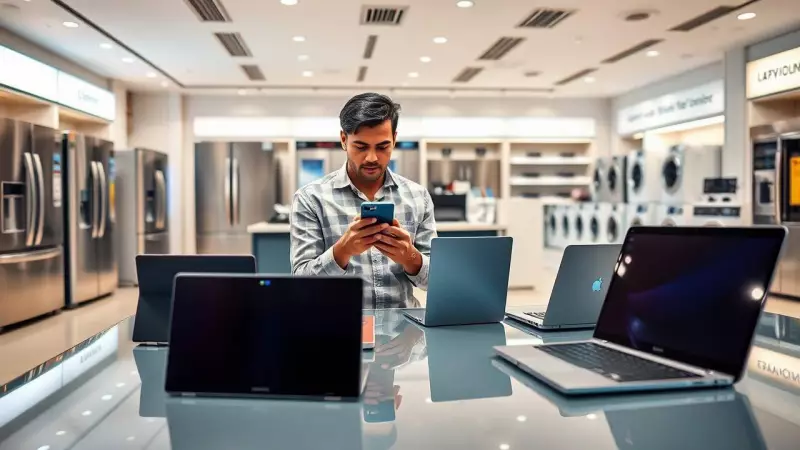
Indian consumers are decisively moving towards premium, feature-rich, and larger electronic products, according to the latest annual report from retail giant Croma. The Croma Year-End Consumer Trends 2025 analysis, which tracks purchasing patterns across its nationwide online and offline network, highlights a significant evolution in buyer behaviour. The findings point to a market where smart convenience, health-conscious choices, and aspirational upgrades are driving growth across smartphones, laptops, home entertainment, and appliances.
Smartphones and Laptops: The Premium Push
The smartphone segment witnessed robust year-on-year growth with a clear trend towards higher price brackets. One out of every three new phones sold was in the Rs 20,000 to Rs 30,000 category, indicating a strong mid-premium demand. Furthermore, nearly 20% of buyers chose flagship or ultra-premium models. The most staggering growth was seen in the Rs 50,000 to Rs 58,000 segment, which surged by over 300%. This spike is attributed to consumers willing to spend more on devices tailored for advanced use cases like content creation, gaming, and AI applications.
Mirroring this trend, the laptop market recorded strong double-digit overall growth. Demand was led by premium and AI-focused machines. The report identified Bengaluru, Mumbai, and Delhi as India's "Silicon Triad," spearheading the adoption of AI PCs and high-performance systems. Apple's M4 laptops dominated the top tier, while Nvidia-powered gaming systems continued their expansion. Gaming laptops in the pro-performance category grew by more than 25%, and ultra-thin laptops doubled their growth rate as buyers sought a blend of lightweight design and powerful performance.

Home Entertainment Gets Bigger and Smarter
Indian households are significantly upgrading their viewing experience, leading to a reshaping of home-entertainment patterns. Bengaluru recorded the highest sales for 65-inch televisions in the country. Mumbai led the demand for even larger screens, specifically 75-inch and above displays, while Gurugram emerged as the strongest market for future-ready 8K televisions. The focus on immersive experiences extended to audio, with Delhi-NCR registering the highest demand for advanced sound systems, cementing the region's status as a key hub for sophisticated at-home social entertainment.
Appliances: Efficiency, Health, and Automation Take Centre Stage
The home appliance sector showed a distinct shift towards premium, efficient, and health-oriented products. In cooling products, while Delhi and Mumbai had almost equal demand for air conditioners, efficiency became a key differentiator. Nationally, one in four ACs sold was a 5-star model, but in Delhi, this ratio was nearly one in three, reflecting growing climate awareness and a preference for long-term energy savings. Smart ACs constituted 32% of total sales, and North India showed rising interest in all-season ACs that function as heaters with lower power consumption.
Large appliances continued their move up the value ladder. Front-load washing machines posted strong double-digit growth, led by early-adopter cities like Bengaluru and Pune. In refrigerators, Delhi drove demand for spacious side-by-side models, followed by other major metros including Bengaluru, Mumbai, Hyderabad, and Ahmedabad, highlighting a preference for larger-capacity units.
Health-focused appliances gained remarkable momentum. Air fryer sales grew by nearly 38% year-on-year, with Mumbai at the forefront. Air purifiers, once concentrated in Delhi-NCR, expanded into Mumbai and Bengaluru as worsening air quality pushed more households to invest in cleaner air. Water purifier sales also saw a notable rise, with Bengaluru becoming the biggest market, followed by Mumbai, Pune, and Hyderabad, indicating increased awareness about water quality.
The biggest breakout trend of the year was smart convenience. Automated and robotic appliances saw nearly twofold growth, with Bengaluru leading the adoption and establishing itself as India's top market for home robotics, showcasing the city's appetite for cutting-edge domestic technology.






