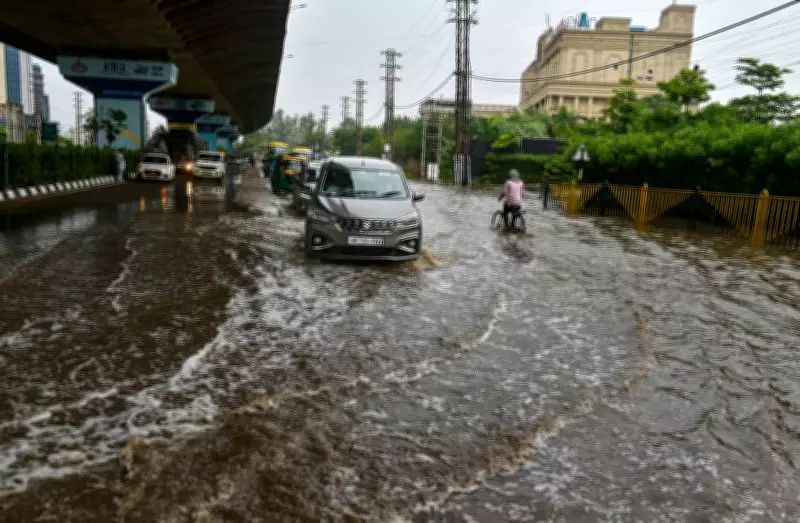
Gurugram has been brought to a standstill by relentless heavy rain, with 350mm of precipitation recorded over the past two days overwhelming the city's drainage network in several areas, even as civic agencies claimed success elsewhere. The Delhi-Jaipur Highway (NH-8) bore the brunt of the disruption, with a stretch near Narsinghpur experiencing a road cave-in on Tuesday evening.
NH-8 Cave-In and Traffic Chaos
The cave-in occurred at a site where the Gurugram Metropolitan Development Authority (GMDA) has been using trenchless technology to lay a storm water drainage culvert. The National Highways Authority of India (NHAI), in a post on its official X account, held GMDA responsible for the collapse, stating that water had seeped through utility ducts and pipes during the rain and washed away the soil supporting the carriageway at the culvert site.
The incident forced authorities to barricade two of the four lanes for nearly two days, triggering a three-kilometre traffic jam by Wednesday afternoon. Traffic police repeatedly shut the Hero Honda Chowk flyover to manage the flow, but this diverted vehicles onto the Southern Peripheral Road, Umang Bhardwaj Chowk, and routes toward the Dwarka Expressway. At several junctions, drivers abandoned their vehicles and waded through floodwater. More than 1,000 personnel were deployed across key points to manage the situation.

Civic Agencies Defend Preparedness
Civic authorities sought to defend their preparedness amid the chaos. Municipal Corporation of Gurugram (MCG) and GMDA officials said their response time to waterlogging complaints had been reduced to 30 minutes, and that most known vulnerable spots had been rectified ahead of the monsoon season.
GMDA Chief Executive Officer P.C. Meena stated that the authority had identified 42 waterlogging-prone locations citywide, and that drainage strengthening work—including desilting, storm water channel restoration, and improved connectivity—meant most of these stayed largely clear during Tuesday and Wednesday's downpour. He cited AIT Chowk, Tulip Chowk, Medanta Road, Rezang La Chowk, and the Sector 22/23 and 45/46 stretches as locations where the measures held up, along with the entire Southern Peripheral Road corridor and the Hero Honda Chowk–Umang Bhardwaj Chowk stretch, where desilted drains prevented prolonged accumulation. Sectors 9 and 9A, flagged for severe waterlogging last year, also saw no major flooding this time, he said.
The Municipal Corporation of Gurugram struck a similar note. Mayor Rajrani Malhotra said pre-monsoon work, including de-watering of 28 ponds to boost their storage capacity, had kept areas such as Rajendra Park, Sector 17, and Wards 30 and 32 free of flooding despite the heavy rain. Commissioner Pradeep Dahiya said the civic body's focus had shifted from temporary fixes to permanent drainage solutions, with field teams directed to keep monitoring sensitive spots round the clock.
Coordination Gaps and Civic Planning Questions
The claims sit uneasily against Wednesday's scenes on NH-8, where the cave-in and resulting bottleneck point to a coordination gap between highway and civic agencies rather than a localised drainage failure. This revives questions about how far the city's civic planning has kept pace with its rapid expansion.