

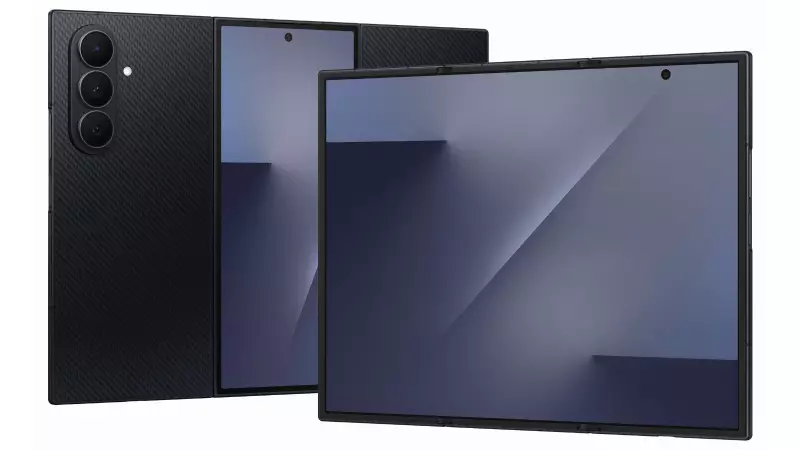
Samsung Electronics has officially announced the launch date for its groundbreaking trifold smartphone, the Samsung Z TriFold. The device is set to make its market debut in South Korea on December 12, 2025, with a subsequent release in the United States planned for the first quarter of 2026. This launch marks a significant evolution in the foldable phone segment, pushing the boundaries of screen real estate and multitasking capabilities.
Design and Display: A New Foldable Form Factor
The Samsung Z TriFold introduces a novel inward-folding design that aims to protect its primary screen. When unfolded, users are greeted by a massive 10-inch diagonal inner display boasting a resolution of 2160 x 1584 pixels. This panel supports an adaptive refresh rate that can scale from a smooth 120 Hz down to an energy-efficient 1 Hz.
On the outside, the device features a 6.5-inch cover screen with a 1080p resolution and a 21:9 aspect ratio, similar to the exterior of the Galaxy Z Fold 7. The engineering challenge of a trifold design is evident in its dimensions: when folded, the TriFold measures 12.9mm in thickness. This makes it notably thicker than the Galaxy S25 Ultra (by 4.7mm) and the Z Fold 7 (8.9mm), but closer to the profile of the Z Fold 6 (12.1mm).

Samsung has employed a sophisticated hinge mechanism named the titanium Armour FlexHinge. It utilizes two different-sized hinges working in tandem with a dual-rail framework. A unique alarm system alerts the user if the device is folded incorrectly. The company claims this design ensures a smoother fold and increased longevity, partly due to a protective thin metal piece within the mechanism.
Power, Performance, and Camera Capabilities
At its core, the Z TriFold is a powerhouse. It is driven by the high-performance Snapdragon 8 Elite for Galaxy chipset, coupled with a substantial 16GB of RAM. The device houses a total battery capacity of 5,600 mAh, split between the two screens to power the large display effectively.
For photography enthusiasts, Samsung has equipped the TriFold with a versatile triple-camera array on the rear:
- A 200-megapixel wide-angle sensor
- A 12-megapixel ultrawide-angle lens
- A 10-megapixel telephoto camera
For selfies and video calls, a 10-megapixel front-facing camera is present on both the cover screen and the inner display. Notably, Samsung has decided to remove stylus (S Pen) support in this model, a feature available in previous Z Fold iterations.
Standalone DeX and Durability Features
One of the most compelling software features of the Z TriFold is its enhanced Samsung DeX experience. The device can operate the DeX desktop environment in a standalone mode, eliminating the need for an external monitor. This allows users to run three vertically aligned applications simultaneously on the expansive screen, transforming the phone into a highly portable productivity workstation.
Durability has been a key focus. The back panel is constructed from a ceramic-glass fibre-reinforced polymer to resist cracks. The hinges are housed in titanium for added strength. The device carries an IP48 rating, meaning it offers full protection against water ingress but is not completely dust-tight.
In a direct comparison with a key competitor, the Z TriFold is nearly identical in size to Huawei's Mate XT, being marginally thicker (12.9mm vs. 12.8mm) and slightly heavier (309 grams vs. 298 grams). However, it uses a different folding approach, with its sides folding inward over the centre panel, unlike the Z-fold design of the Mate XT.
The announcement has set the stage for the next chapter in foldable technology. While Samsung has revealed comprehensive specifications and the launch timeline, one critical detail remains undisclosed: the pricing for both the Korean and US markets. Tech enthusiasts and industry watchers will be keenly awaiting this final piece of information as the December 12 launch date approaches.






