

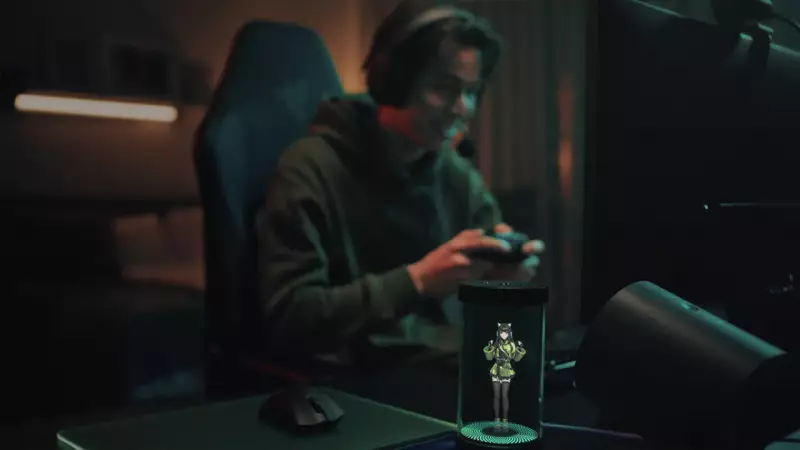
At the CES 2026 tech showcase, gaming hardware giant Razer has unveiled a futuristic vision for desktop companionship. The company introduced Project AVA, a 5.5-inch holographic AI assistant designed to sit on your desk, coach your gameplay, and help organize your daily life. This glowing cylindrical device is built with a distinct gamer aesthetic and promises to be more than just a virtual helper.
Hardware and Core AI Capabilities
The Project AVA hardware is packed with features to make interactions seamless. It includes dual far-field microphones and an HD camera for clear communication. It connects to Windows PCs via a USB-C port, enabling a feature Razer calls "PC Vision Mode." This allows the AI to analyze your computer screen in real-time. Whether you are struggling with a loadout menu in a game like Battlefield 6 or working through complex spreadsheets, AVA can see what you see and offer context-aware assistance.
For its brain, the current build of AVA runs on xAI's Grok engine. However, Razer has stated that future updates will bring compatibility with other major AI platforms, including their own proprietary system. This move indicates a flexible approach to AI development for the device.

Five Unique Personalities and Expanded Functions
One of the most intriguing aspects of Project AVA is its personality. Users are not locked into a single digital character. Razer, in collaboration with Animation Inc., has developed five distinct avatars for the assistant. The lineup includes the efficient default AVA, the supportive catgirl KIRA, the tattooed strategist ZANE, the esports legend FAKER, and the influencer-inspired SAO. Each avatar features motion-tracked facial expressions and responsive eye movements during conversations, aiming to create a more lifelike interaction.
Beyond offering gaming tips that Razer claims won't violate terms of service, AVA's functionality extends into everyday life. The assistant can handle tasks like scheduling, wellness tracking, translation, and professional consulting. When asked about the nature of user relationships with AVA, Razer CEO Min-Liang Tan told Bloomberg that the goal is not to foster romantic connections. However, the company acknowledged that people often use AI in a more personal manner, a subtle nod to how such technology is adopted by users.
Availability and Market Prospects
Razer plans to start shipping Project AVA in the second half of 2026. For customers in the United States, the company has already opened reservations through its official website. Interested buyers can secure a unit with a $20 refundable deposit, although the final retail price has not yet been disclosed.
The success of this ambitious project remains to be seen. Whether holographic desk companions become the next major frontier in gaming and productivity tech or end up as a quirky footnote from CES depends entirely on consumer adoption. Razer is betting that a significant number of gamers want their digital backseat driver to be not just smart, but also a little cute and personalized.






