

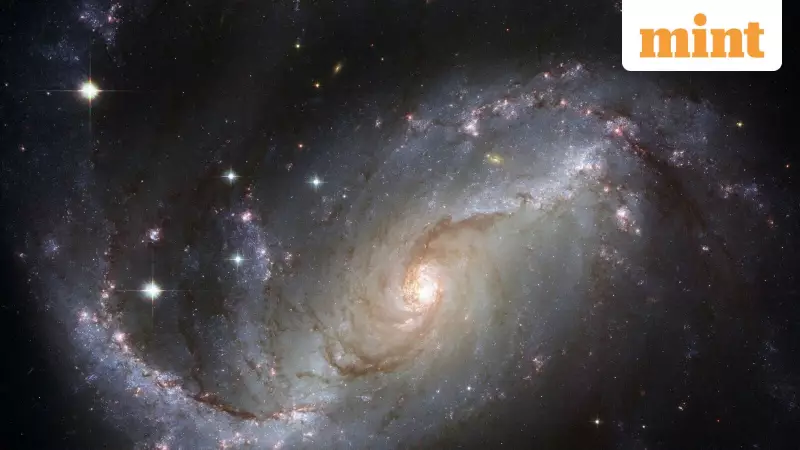
The year 2025 will be etched in history as a period of monumental firsts in the scientific realm. From peering deeper into the cosmos than ever before to achieving critical tipping points on Earth, groundbreaking discoveries and technological leaps have redefined possibilities. As we close the chapter on this remarkable year, let's delve into the most significant science stories that captivated India and the world, and understand their profound implications for our future.
A New Eye on the Cosmos: The Universe in Unprecedented Detail
After more than ten years of eager anticipation, the Vera C. Rubin Observatory officially began its mission this year from its base in Chile. Named in honour of the pioneering American astronomer, this facility houses a revolutionary 3,200-megapixel camera, the largest ever built. Unlike traditional telescopes that zoom in on specific celestial targets, this observatory will perform a sweeping survey of the entire visible southern sky every few nights.
This ambitious project aims to create a decade-long time-lapse film of the universe, effectively allowing humanity to witness cosmic evolution in real time. Over its operational life, it is projected to catalogue an astonishing 20 billion galaxies and 17 billion stars, along with countless supernovae and asteroids. With full survey operations starting in early 2026, the data is poised to unlock the mysteries of dark energy and dark matter, fundamentally altering our comprehension of the cosmos.

Earth's Green Milestone and Medical Hope
On the energy front, 2025 witnessed a historic and psychological shift. For the first time, global electricity generation from renewable sources officially surpassed coal. Driven by plummeting costs and a massive solar capacity surge, particularly in China and Europe, this marks a crucial tipping point. The debate about renewables being unreliable or too expensive has been decisively put to rest. The focus now shifts to enhancing energy storage and modernising power grids for a sustainable future.
In medical science, a beacon of hope emerged for Huntington's Disease, a devastating genetic disorder previously considered untreatable. Neuroscientist Sarah Tabrizi led clinical trials that successfully demonstrated a 75% slowing of the disease's progression. This first-ever "disease-modifying" success using "gene silencing" techniques transforms Huntington's from a terminal diagnosis to a manageable condition. It also paves the way for similar approaches against other neurodegenerative diseases like Alzheimer's and Parkinson's.
Visitors from Afar and Personalised Cures
The year also treated sky-watchers to a rare celestial guest: the interstellar object 3I/ATLAS. As only the third documented visitor from beyond our solar system, its passage sparked global fascination and wild speculation. Scientists worldwide tracked it closely, obtaining a "free sample" that revealed a chemical makeup distinct from anything in our solar system. This event has accelerated plans for future interceptor missions to physically sample such objects.
Meanwhile, genetic medicine entered a new era with a highly personalised breakthrough. Scientists used CRISPR technology to create a one-of-a-kind cure for a baby, identified as KJ, born with a unique, untreatable mutation. They programmed a custom genetic editor, manufactured the cure, and administered it in record time, correcting the error in the infant's liver cells. This "N=1 Medicine" proof-of-concept challenges the entire pharmaceutical model, proving that tailored genetic editing can save a single life.
Tech Revolution: Efficient AI and Quantum Leap
In the world of artificial intelligence, concerns about its massive energy consumption were addressed head-on. While US tech giants built power-hungry data centres, a Chinese team led by Liang Wenfeng released the DeepSeek open-source model. It demonstrated that top-tier AI reasoning doesn't require exorbitant power, matching the performance of models like GPT-5 using only a fraction of the energy. This breakthrough democratises AI access, allowing universities and smaller labs to run advanced models locally.

Finally, China also reported a significant stride in quantum computing. The new Zuchongzhi 3.0 superconducting quantum chip solved a complex sampling problem a quadrillion times faster than the world's fastest classical supercomputer. While the calculation was abstract, it proved quantum hardware is scaling rapidly. This "quantum advantage" signals an urgent need to overhaul global internet security and encryption standards before such machines can break current codes.
From the vastness of space to the code of life and the algorithms of the future, 2025 has set the stage for a new decade of scientific transformation, offering solutions to some of humanity's oldest challenges and opening doors to realms once confined to science fiction.





