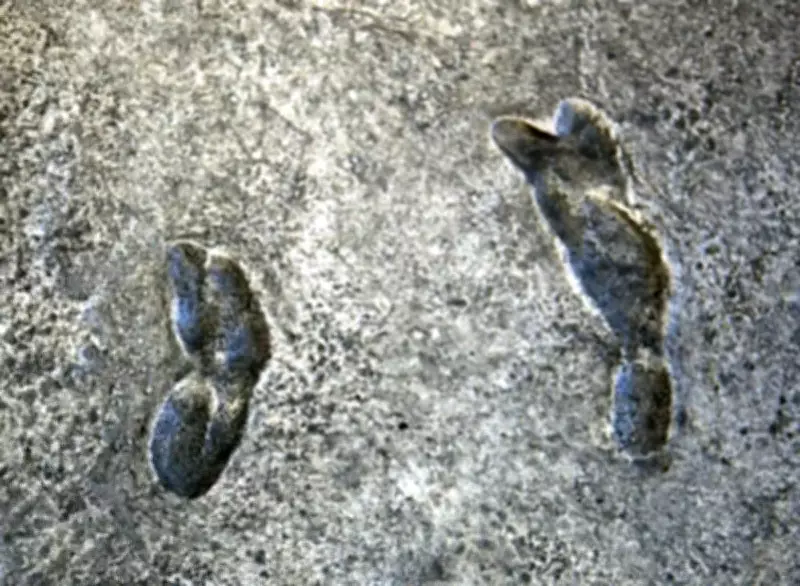
A routine fieldwork day in the dry savanna of East Africa unexpectedly transformed the scientific understanding of human evolution. While studying an arid region in northern Tanzania, a research team led by paleontologist Mary Leakey examined a layer of volcanic ash spanning a vast area. The site, known as Laetoli, was already recognized for its fossil content, but it harbored an extraordinary record of ancient behavior.
As investigators carefully brushed away loose surface dust, they uncovered a series of distinct indentations deeply pressed into the prehistoric crust. The field scientists quickly realized that this was a clear record of evolution. Instead of providing skeletal fragments like jaws and teeth, the location offered a vivid snapshot of how early humans walked on two feet. Long ago, an eruption from a local volcano blanketed the area with fine, powdery gray ash. Shortly after the volcanic activity, a rain shower created a perfect mold of the individuals' walking patterns, until a second layer of ash sealed the prints.
Pushing Upright Walking Further into the Deep Past
The discovery and preservation of this ancient trail captured global attention as it provided direct evidence of bipedalism. According to a study published in the journal PLOS ONE, the trails are estimated to be about 3.6 million years old. This timeline established them as the oldest unequivocal evidence of obligate bipedalism in the human lineage known at that time.

Earlier anthropological theories often speculated about the specific locomotion of our earliest ancestors and whether they were adapted to terrestrial bipedalism. The impressions found in the ash at Laetoli have been instrumental in settling this debate. Another study in the Proceedings of the Royal Society B: Biological Sciences states that these tracks reflect an extended limb and efficient gait. Although there are mechanical differences compared to modern humans, the gait is described as an upright posture demonstrating the adaptation of our predecessors to bipedalism.
Reconstructing a Journey Across the Savanna Plains
This archaeological site continues to yield scientific insights as modern technologies allow experts to investigate the characteristics of the individuals who left the prints. An informative review published by the Smithsonian Institution Human Origins Program, titled Laetoli Footprint Trails, states that the trails were most likely made by individuals belonging to Australopithecus afarensis — the same species as the celebrated fossil named Lucy. The spacing of the tracks reveals a clear behavioral snapshot, showing a trail of individuals walking across the volcanic landscape.
Today, this ancient African landscape is celebrated as a foundational milestone in evolutionary biology, demonstrating how insights into human behavior can emerge from simple marks in the crust. The enduring legacy of the 1976 discovery serves as a reminder that our collective lineage has a long history of bipedal travel. It shows that early hominins moved across their world in a stable, upright manner, adapting to the challenges of their environment step by step.
It remains a striking reality that when people travel to Africa today to see animals on the savannas, they are walking near the exact traces left by their early human relatives, which rest safely beneath the surface of the hardened volcanic ash.