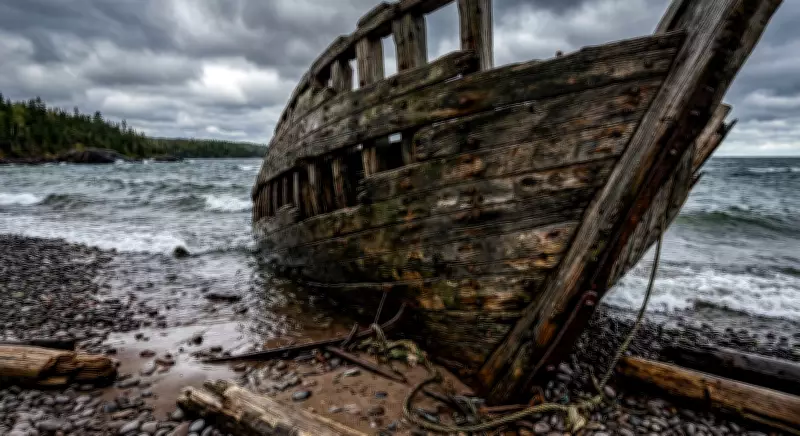
What started as an ordinary day at the beach near Goderich, Ontario, turned into one of the most remarkable maritime discoveries in recent memory, and the person responsible for it was an eight-year-old boy.
A Child's Discovery on Lake Huron
In 2023, a third-grade boy was doing what children often do on vacation when given a metal detector: sweeping it across the sand, hoping to find a lost coin or perhaps a bottle cap. Near the shore of Lake Huron, he stumbled upon half-buried bits of metal. Those fragments turned out to be the first visible evidence of a 19th-century shipwreck, a vessel that had rested at the bottom of the lake for nearly 170 years.
The Great Lakes as Time Capsules
What many people outside the region do not fully understand is that the Great Lakes are incredible time capsules. Lake Huron, in particular, offers some of the best conditions in the world for shipwreck preservation. According to NOAA, the cold, fresh water of the lake dramatically slows decay, leaving old vessels much more intact than they would be in warmer ocean environments. Salt water is corrosive, and warm water accelerates biological decomposition.

Researchers have discovered nearly 100 historic shipwrecks in nearby Thunder Bay alone, an area often called Shipwreck Alley. That is why a ship that sank sometime in the 1850s could still leave recognizable metal fragments on a beach in 2023.
How Shipwreck Discoveries Happen
One might be tempted to call such a find pure luck: the right place, the right child, the right detector. However, any maritime archaeologist will confirm that most shipwreck discoveries begin exactly like this: a piece on a beach, an oddity in the sand, something that does not quite fit. The cold freshwater conditions of Lake Huron have preserved hundreds of historic shipwrecks in near-perfect condition, some dating back to the early 1800s.
NOAA's shipwreck research program, as described in the article Searching for shipwrecks in Thunder Bay National Marine Sanctuary, outlines the process of identifying wrecks as a careful comparison, where physical evidence is matched with historical records, shipping logs, and survey data. It begins when someone notices something unusual on the beach. What matters is what happens next: the fragments are studied, experts are consulted, and the past is slowly reconstructed.
The Historical Context of the Goderich Wreck
The Goderich wreck dates from the 19th century, a time when shipping on the Great Lakes was booming and perilous. These waters were a commercial lifeline to the growing American and Canadian interior, and they claimed ships regularly. Weather changed quickly, navigation was primitive by modern standards, and shoals were poorly marked. Ships went down with little trace and were recorded as lost.
Finding one of them 170 years later is more than just a heartwarming story; it is a small piece of that era coming back into focus.
The Lesson from a Third-Grader
This stretch of Ontario shoreline is not remote wilderness. It is a frequently visited beach, and those bits of metal had been there for who knows how long, waiting for someone to notice. It took a child with a metal detector and no preconceived notions about what he would find.
The maritime history of the Great Lakes is often out of sight, literally underwater or buried under decades of sand, but it does not disappear. It is preserved by the cold water of the lake, and sometimes it breaks through just enough to remind us it is there. The boy made no effort to make history at Goderich; all he needed to do was keep his eyes open.