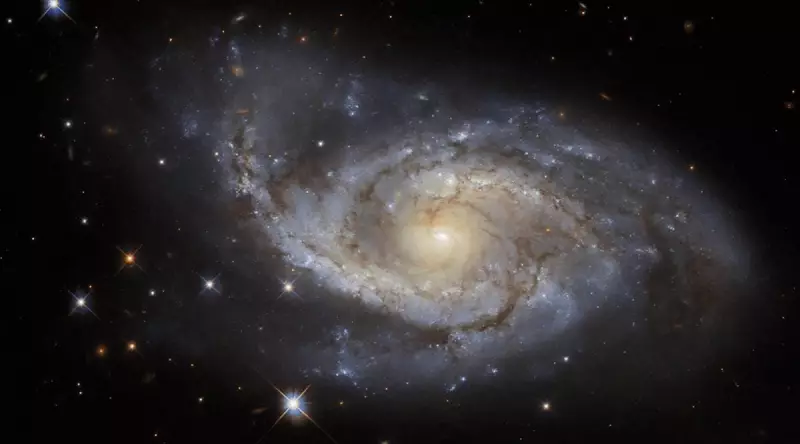
In a discovery that is sending shockwaves through the astronomical community, the powerful James Webb Space Telescope (JWST) has spotted an ancient galaxy that fundamentally challenges long-held theories about how galaxies like our Milky Way form and evolve. Named 'Alaknanda' after the Himalayan river, this celestial object existed when the universe was remarkably young, yet it boasts a mature structure and mass comparable to our own galaxy, defying conventional timelines of cosmic evolution.
The Galactic Rulebook is Rewritten
For decades, astronomers have operated on a foundational principle: large, majestic spiral galaxies are cosmic latecomers. The prevailing 'bottom-up' theory suggested that the universe started with small, humble galaxies. Over billions of years, through a series of mergers and acquisitions, these small entities slowly assembled into the massive spirals we see today, like our Milky Way. Forming the distinct, delicate spiral arms was thought to be a complex, time-consuming process that required a relatively quiet and mature universe.
The discovery of the Alaknanda galaxy, along with others like 'Zhúlóng' and 'Big Wheel', is turning this rulebook to dust. Researchers Rashi Jain and Yogesh Wadadekar from the National Centre of Radio Astrophysics in Pune identified Alaknanda by using a cosmic magnifying glass—a phenomenon called gravitational lensing. They peered through a massive cluster of galaxies whose gravity warps and amplifies the light from objects far behind it, bringing the distant Alaknanda into view.

Alaknanda: An Ancient Cosmic Anomaly
The data from JWST presents a portrait of a galaxy that, by traditional standards, shouldn't exist in such a mature state so early in cosmic history. Analysis of the light spectrum reveals that Alaknanda appears to have existed when the universe was only about a fifth of its current size, a mere few billion years after the Big Bang. Its stars are estimated to be just a few hundred million years old.
Most startlingly, Alaknanda displays clearly discernible spiral arms and possesses a stellar mass similar to the Milky Way. Its spectrum also indicates the presence of a moderate amount of cosmic dust, which is both a by-product and a necessary ingredient for star formation. This finding, announced in December 2024, adds to a growing list of ancient, massive, and structured galaxies that are being uncovered by the JWST, each one a puzzle piece that doesn't fit the old picture.
Implications and a New Cosmic Dawn for Theory
The consecutive discoveries of Zhúlóng, Big Wheel, and now Alaknanda are not mere curiosities; they represent a significant trend that compels a scientific paradigm shift. The numbers for mass and age, while dependent on certain theoretical models and taken with a degree of caution, consistently point in one direction: the early universe was far more efficient and prolific at building complex, massive galactic structures than anyone had predicted.
This forces astrophysicists to go back to the drawing board. Did galaxy formation start with larger seeds? Were the processes of star formation and spiral arm development dramatically faster and more robust in the primordial universe? The comfortable, gradual timeline of galactic 'rags-to-riches' stories is now under intense scrutiny.
The work of Jain and Wadadekar, published on December 4, 2024, in The Indian Express, underscores a thrilling era in cosmology. As the James Webb Space Telescope continues to peer deeper into the past, each new observation has the potential to overturn another cherished assumption. The universe, it seems, is proving to be a much more capable and speedy architect than we ever imagined, building its grandest designs in a fraction of the time we thought possible.