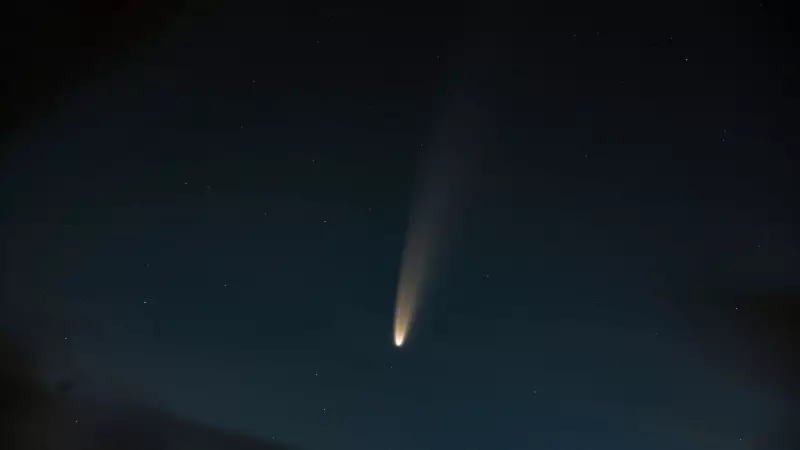
In a groundbreaking discovery that sheds light on the chemistry of alien star systems, scientists have detected unusually high levels of methanol in the interstellar comet 3I/ATLAS. This marks the first time this key molecule, central to prebiotic chemistry and the origins of life, has been found in an object visiting our solar system from deep interstellar space.
A Visitor Unlike Any Other
The comet 3I/ATLAS is only the third known interstellar visitor to our cosmic neighbourhood, and it is proving to be strikingly different from comets native to our solar system. As it journeyed toward the sun, astronomers observed a rapidly expanding cloud of gas and water vapour around it. This coma was packed with far more carbon dioxide than typical and emitted a noticeably redder light, hinting at a unique and alien surface composition.
Remarkably, the comet began releasing gas while still very far from the sun's heat. This behaviour suggests it may not have approached a star for hundreds of millions of years, possibly not since it was ejected from its original, unknown star system.

NASA-Led Team Uncovers Alien Chemistry
A research team led by Martin Cordiner of NASA's Goddard Space Flight Center used the powerful Atacama Large Millimeter/submillimeter Array (ALMA) in Chile to conduct a detailed chemical investigation. Their observations, detailed in findings reported in December 2025, revealed a chemical profile never before seen in a local comet.
The team found that 3I/ATLAS is emitting substantial amounts of hydrogen cyanide from close to its nucleus, at a rate between 250 and 500 grams per second. Even more significant was the detection of methanol. This simple carbon-based compound, a crucial building block for more complex organic molecules, was found in astonishing abundance.
"Hydrogen cyanide and methanol usually appear only in small traces in our own comets," Cordiner stated. "But in this interstellar object, they seem to be unusually abundant."
Methanol: A Clue to Origins and Life's Building Blocks
The methanol production from 3I/ATLAS is especially striking. It is being released at a rate of roughly 40 kilograms per second, accounting for about 8 per cent of all vapour streaming from the comet. For comparison, typical solar system comets produce only around 2 per cent methanol.
The fact that methanol and hydrogen cyanide appear to be coming from different regions of the comet suggests its nucleus may be compositionally uneven. This offers scientists rare clues about how such an object formed in another star system.
Methanol acts as a fundamental stepping stone in the chemical pathways that can lead to the molecules of life. Cordiner explained that such high methanol levels typically indicate other important chemical reactions are occurring. "It's very unlikely you can reach high chemical complexity without producing methanol along the way," he added.
Researchers, including Josep Trigo-Rodríguez of the Institute of Space Sciences in Spain, have a theory. They previously predicted that a metal-rich comet containing abundant iron would generate large quantities of methanol. Heat from the sun could melt subsurface ice, allowing water to react with iron-bearing minerals inside the nucleus to form methanol. Therefore, detecting vast amounts of methanol could indicate that 3I/ATLAS is rich in metals, providing another tantalising clue to its ancient and alien origins.
This discovery not only highlights the unique nature of interstellar visitors but also reinforces the idea that the chemical ingredients for life may be common—and perhaps even more potent—in planetary systems across the galaxy.