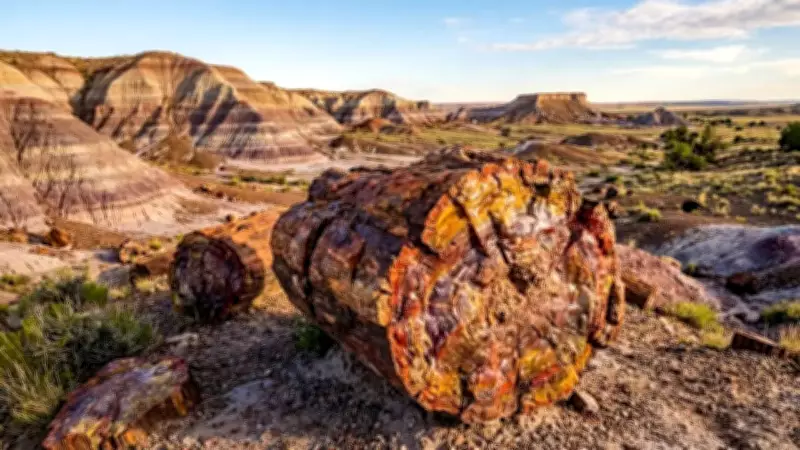
In Arizona's dry, rugged badlands, you can find something far more valuable than any glittering gold: the Petrified Forest. These aren't just old trees; they are stone ones, dating back approximately 225 million years to the Late Triassic period. This transformation occurred due to a special chemical process, where volcanic ash and groundwater rich in silica gradually turned living wood into quartz and jasper. Unlike gold, which is a chemically inert mineral, this petrified wood acts like a true biological time capsule. It preserves the tiny cell structures of long-extinct plants, providing a glimpse into Earth's climate from that era. For scientists, these logs are not merely interesting; they are incredibly important pieces of information, revealing how ecosystems adapted to significant environmental changes long before dinosaurs dominated the planet.
How Arizona's Petrified Wood Helps Scientists Map Earth's Ancient Timeline
When researchers study the Petrified Forest, they recognize its true value in helping to map geological time. Gold may remain unchanged, but these logs are different. They contain tiny volcanic crystals, enabling highly accurate radio-isotopic dating. These crystals function like tiny zircon crystals for uranium-lead dating, allowing scientists to reconstruct a detailed timeline of the Triassic period and better understand the evolution of early life, as noted in a study by the National Park Service. Each log is akin to an ancient computer hard drive, packed with data from prehistory, offering clues about atmospheric conditions and humidity levels from over 200 million years ago.
How Ancient Rivers Turned Forests into Gems
According to a study published by the US Geological Survey, the process of wood turning to stone, often called permineralization, is quite involved. Imagine those ancient trees, millions of years ago, tumbling into ancient river systems. They would be quickly covered by mud and volcanic ash, cutting off oxygen and creating an anaerobic environment. Then, over thousands of years, groundwater saturated with silica slowly infiltrated the wood's cells. As the original organic material gradually broke down, minerals like quartz, manganese, and iron oxide replaced it, painting the wood with vibrant rainbow colors seen today. This process is so intricate that scientists can still examine a piece under a microscope and discern individual tree rings and cell walls.

Using 'Stone Wood' to Trace the History of Life
The Arizona Petrified Forest holds an astonishing amount of petrified wood, more than anywhere else on Earth. Yet, its true scientific value extends beyond those ancient trees. This site also serves as a vast burial ground for massive creatures from the Triassic period, a time when phytosaurs (crocodile-like reptiles) and early dinosaurs roamed. By studying fossilized wood alongside animal remains, scientists can reconstruct what a complete ecosystem looked like millions of years ago. This careful reconstruction helps researchers understand how plants and animals co-evolved, offering insights that make the forest an open-air laboratory for studying biotic turnover and climate oscillations.
Why Displaced Fossils Lose Their Value
Despite federal protection, the park constantly struggles against people removing pieces of wood. Each time a piece is taken, a crucial part of a scientific puzzle vanishes. Interestingly, the park has a collection called the 'Conscience Pile,' made up of wood returned by visitors who later believe the stones bring bad luck. From a researcher's standpoint, once a piece is moved from its original location, its stratigraphic and spatial context—and geological layer—are lost. This renders it essentially useless for precise scientific study.