

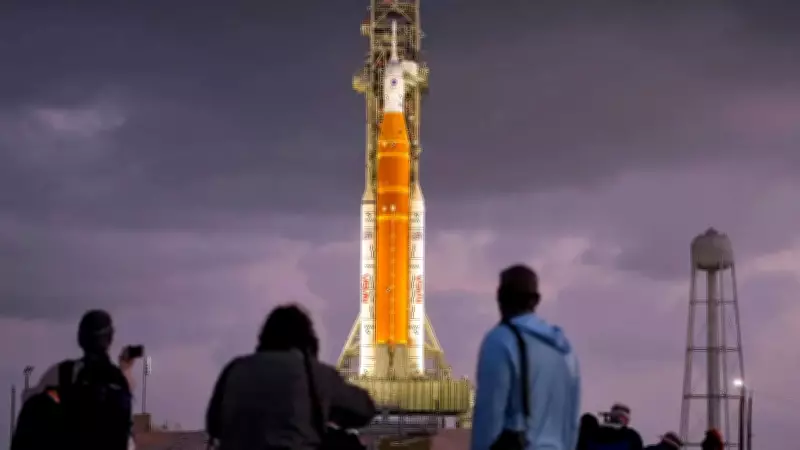
NASA's Artemis II Mission: Four Astronauts Approach Historic Lunar Flyby
Four astronauts are now on the brink of a monumental achievement as NASA's Artemis II mission nears its most critical phase: a lunar flyby. This event represents the first crewed deep-space mission in over 50 years, launching on April 2 for a 10-day journey designed as a comprehensive rehearsal for future human landings on the Moon.
The mission marks a historic return to deep space exploration, with astronauts traveling beyond low Earth orbit for the first time since 1972. They are aboard the Orion spacecraft, propelled by the powerful Space Launch System rocket, pushing the boundaries of human spaceflight.
Crew and Mission Objectives
The four-member crew includes Commander Reid Wiseman, Pilot Victor Glover, and Mission Specialists Christina Koch and Jeremy Hansen. Their primary focus is on testing essential systems for sustained lunar exploration. This includes evaluating life-support mechanisms, navigation accuracy, and human performance in the harsh environment of deep space.

Unlike the Apollo missions that landed on the lunar surface, Artemis II will not touch down. Instead, it aims to validate technologies crucial for long-term lunar presence. Key areas under scrutiny are crew health monitoring, studies on radiation exposure, and spacecraft handling in cislunar space—the region between Earth and the Moon.
Journey to the Moon
After a successful launch, the Orion spacecraft spent nearly a day in high Earth orbit, undergoing rigorous system checks. It then executed a translunar injection burn, a precise maneuver that set it on a "free-return" trajectory toward the Moon. Over the past four days, Orion has been steadily advancing, surpassing the distances of all previous human spaceflights and approaching lunar proximity.
Flyby Timeline and Key Events
The lunar flyby, the defining moment of the Artemis II mission, is scheduled to commence around 12:15 AM IST on April 7. This phase includes several critical milestones:
- Closest Approach: Orion will pass approximately 6,500 kilometers above the far side of the Moon.
- Duration: The spacecraft will spend roughly six hours in the lunar vicinity.
- Communication Blackout: A period of about 40 minutes, expected between 6:15 AM and 6:55 AM on April 7, when Orion moves behind the Moon, temporarily cutting off contact with Earth.
- Return Trajectory: Utilizing the Moon's gravity, Orion will be slung back toward Earth without requiring major propulsion burns, showcasing efficient orbital mechanics.
NASA's Focus Areas
This flyby is far from symbolic; it serves as a vital test for future missions. Engineers and mission controllers are closely monitoring several aspects:
- Accuracy of Orion's navigation and propulsion systems.
- Reliability of deep space communication via the Deep Space Network.
- Crew responses to prolonged isolation and increased radiation exposure.
- Imaging of lunar terrain, with special attention to the far side, which remains less explored.
Additionally, the mission will attempt to recreate the iconic "Earthrise" perspective, capturing Earth as it appears over the lunar horizon. This view, first seen during Apollo missions, profoundly influenced humanity's perception of our planet.
The Road Ahead
Following the flyby, Orion will embark on a four-day journey back to Earth. This will culminate in a high-speed re-entry—the fastest ever attempted by a crewed spacecraft—before splashing down in the Pacific Ocean. Artemis II is fundamentally a systems test; its success is crucial for paving the way to Artemis III, which aims to return humans to the lunar surface later this decade.
For now, global attention is fixed on the far side of the Moon. During the 40-minute communication blackout, four astronauts will vanish from Earth's view, symbolizing NASA's long-awaited resurgence in deep space exploration and advancing humanity's quest beyond our home planet.






