

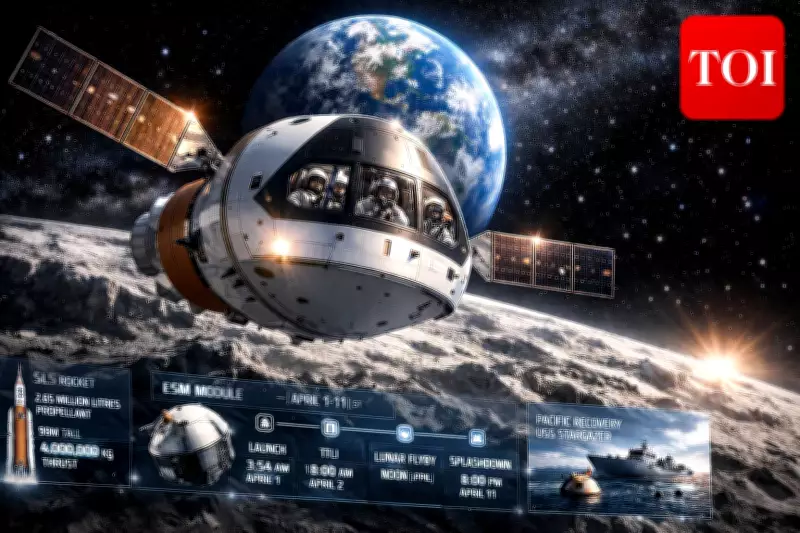
NASA's Artemis II Mission Launches, Sending Astronauts on Historic Moon Voyage
In a landmark revival of human spaceflight beyond low-Earth orbit, NASA's Artemis II mission launched on April 1, propelling four astronauts toward the Moon for the first time since the Apollo 17 mission in 1972. This crewed test flight of the Orion spacecraft and the Space Launch System (SLS) rocket represents a pivotal step in NASA's Artemis program, which aims to establish sustainable lunar exploration and pave the way for future missions to Mars.
Mission Overview and Crew Details
Commanded by Reid Wiseman, with pilots Victor Glover and Jeremy Hansen, and mission specialist Christina Koch, the 10-day journey will validate critical systems for future lunar landings without actually touching down on the lunar surface. The mission serves as a comprehensive rehearsal for upcoming Artemis missions, testing everything from life support to navigation in deep space.
Detailed Mission Timeline and Key Phases
April 1-2: Launch and Earth Orbit

The mission kicked off from Kennedy Space Center's Launch Complex 39B on April 1. After separation from the SLS rocket, the Orion spacecraft entered a 24-hour Earth orbit, a critical shakedown cruise. During this phase, the crew will rigorously test life support systems, propulsion, avionics, and the European Service Module's solar arrays to ensure no issues arise post-launch. This phase mimics Apollo-era checkouts but incorporates modern redundancies, such as Orion's abort system, designed to whisk astronauts to safety if emergencies occur.
April 2-5: Translunar Injection and Lunar Voyage
On April 2, Orion performed its translunar injection (TLI) burn—a 20-minute boost from the main engine that accelerates the capsule to approximately 22,000 mph, sending it moonward at escape velocity. Over the next 3-4 days, covering about 240,000 miles, the crew will monitor autonomous navigation and radiation shielding against hazards like the Van Allen belts and solar flares. While free-floating in microgravity, they will conduct biomedical experiments to study the effects of deep space on the human body, occasionally donning spacesuits for excursions into Orion's cupola-like windows. This transit phase also tests the integrity of the heat shield for reentry and the spacecraft's ability to operate far from Earth.
April 5-6: Heart-Stopping Moon Flyby
Reaching the Moon on April 5, Artemis II will execute a nerve-wracking flyby at an altitude of just 500 miles—closer than many satellites orbit Earth. Over roughly 40 minutes, the crew will capture ultra-high-definition photos and videos of the lunar south pole, a prime target for the planned Artemis III landing in 2027-28. Instruments onboard will map water ice in shadowed craters, data vital for future fuel production and life support systems. The Moon's gravity will then act as a natural slingshot, flinging Orion back toward Earth just 40 minutes later.
April 6-10: High-Speed Return Journey
The return leg mirrors the outbound transit, involving 3-4 days of coasting with final systems checks and scientific operations. As Orion hurtles homeward, the crew will prepare for the grand finale—reentry into Earth's atmosphere at speeds of 25,000 mph, generating plasma temperatures of up to 5,000°F.
April 11: Triumphant Pacific Splashdown
Mission completion is scheduled for April 11, with Orion splashing down in the Pacific Ocean near San Diego. Recovery operations will be handled by the USS Stargazer and divers. Lasting 10 days in total, Artemis II demonstrates that humanity's return to the Moon is not merely a relic of the 1960s but a springboard for multiplanetary life, including lunar bases, resource mining, and Mars ambitions. As Commander Reid Wiseman quipped before launch, "We're going back to stay."
Significance and Future Implications
This mission is more than just a loop around the Moon; it is a crucial rehearsal for establishing sustainable lunar bases, mining resources, and advancing toward Mars. The success of Artemis II will validate technologies and procedures essential for long-term human presence in deep space, marking a new era in space exploration.






