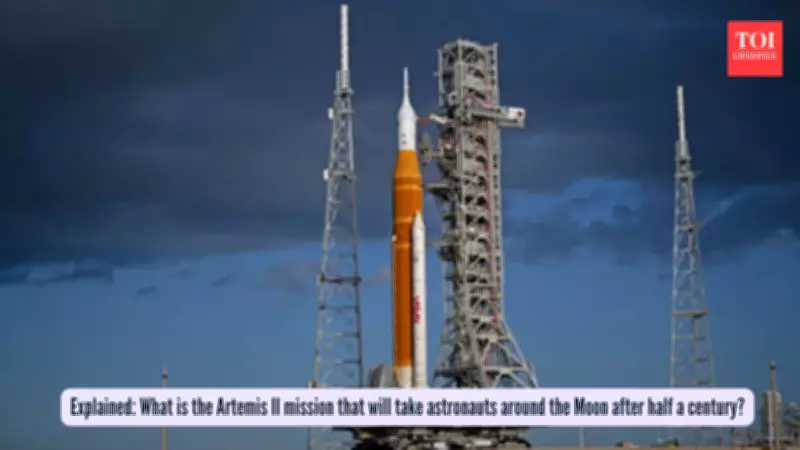
NASA's Artemis II Mission: Paving the Way for Lunar and Martian Exploration
Moon missions serve as vital platforms for scientists to rigorously test advanced technology, conduct in-depth studies of the lunar surface, and systematically prepare for more sophisticated and ambitious space travel endeavors. These missions provide invaluable insights into how astronauts, complex machinery, and intricate systems perform under the extreme and unforgiving conditions far from Earth's protective environment. This knowledge is absolutely critical for planning and executing future missions not only to the Moon but also to the distant and challenging terrain of Mars.
The Historic Artemis II Mission: Objectives and Timeline
The upcoming Artemis II mission represents a monumental and crucial step forward for NASA and global space exploration. Scheduled to commence its launch window in April 2026, this mission will send a crew of four astronauts on a historic journey around the Moon. This event marks the first crewed lunar flyby since the legendary Apollo 17 mission concluded in 1972, ending a gap of nearly half a century in human deep-space travel.
Importantly, Artemis II is not designed as a landing mission. Instead, it functions as a comprehensive proving flight, meticulously testing all the essential systems, protocols, and hardware required for future sustained lunar surface operations and for the significantly longer voyages envisioned for deep-space travel to destinations like Mars. According to detailed mission profiles, the astronauts will embark on an approximately 10-day expedition beyond Earth's orbit. During this time, the spacecraft will complete a looping trajectory around the Moon before returning safely to Earth. This flight profile offers engineers a unique, real-world opportunity to evaluate the performance and resilience of both the spacecraft and its life-support systems under actual deep-space conditions.

Meet the Pioneering Artemis II Astronaut Crew
NASA has assembled a highly experienced and historic crew for this landmark mission:
- Mission Commander Reid Wiseman: A seasoned NASA astronaut with prior experience aboard the International Space Station, Wiseman also served with distinction as NASA's chief astronaut pilot, bringing extensive leadership and operational expertise to the mission.
- Pilot Victor Glover: A NASA astronaut, U.S. Navy captain, and accomplished test pilot, Glover previously flew on the SpaceX Crew-1 mission. He made history by becoming the first Black astronaut to complete a long-duration stay aboard the International Space Station.
- Mission Specialist Christina Koch: A record-holding NASA astronaut, Koch achieved the longest single spaceflight by any woman. She also participated in the pioneering first all-woman spacewalk, demonstrating exceptional skill and endurance.
- Mission Specialist Jeremy Hansen: Representing the Canadian Space Agency, Hansen will be making his inaugural journey to space. He joins this mission as a key participant in the first crewed lunar flight of NASA's ambitious Artemis program.
The Advanced Spacecraft and Rocket Powering the Mission
The mission will be propelled by NASA's formidable Space Launch System (SLS) rocket. Standing at an impressive 322 feet tall, the SLS is the most powerful rocket developed by NASA since the era of the Saturn V. The crew will travel aboard the advanced Orion spacecraft, which is engineered to function as their living quarters, primary command center, and secure return vehicle throughout the entire journey.
The Orion spacecraft is specifically designed as NASA's next-generation deep-space crew vehicle. It is built to withstand the severe hazards of space, including intense radiation exposure, extreme temperature fluctuations, and the absolute vacuum of the cosmos. A specially engineered heat shield is a critical component, designed to protect the astronaut crew during the high-speed, high-temperature re-entry into Earth's atmosphere at the conclusion of their mission.

In preparation for this critical flight, NASA has reported that the Artemis II rocket and Orion spacecraft are undergoing final preparations for rollout to Launch Complex 39B. Simultaneously, the astronaut crew has initiated a standard pre-launch quarantine period. These meticulous checks and procedures are absolutely standard and essential for a mission of this unprecedented scale and complexity, where every single detail must be verified and validated multiple times to ensure absolute safety and mission success before the historic liftoff.