NASA's Artemis II: A New Era of Sustainable Lunar Exploration
NASA's Artemis II mission represents a fundamental transformation in humanity's approach to lunar exploration, moving decisively beyond the brief "flags and footprints" objectives of the 1960s Apollo program toward establishing a framework for long-term, sustainable human presence on the Moon. This mission is not merely a revisit but a comprehensive upgrade in technology, inclusivity, and ambition.
Rocket Power: SLS vs Saturn V
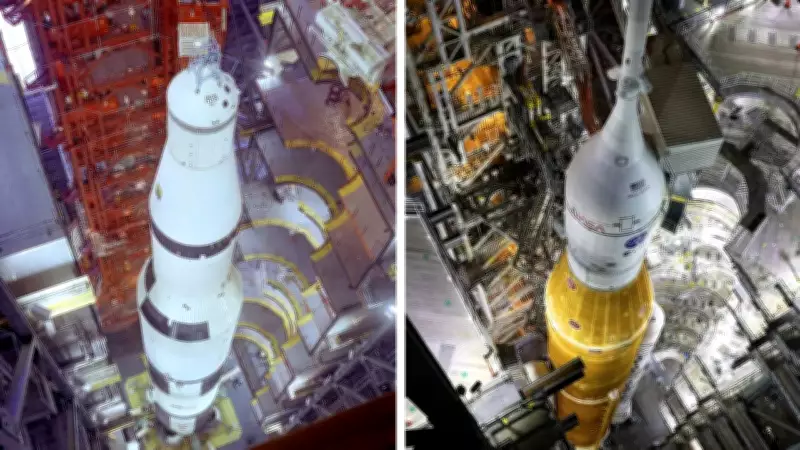
The most visible distinction between the Apollo and Artemis programs lies in their launch vehicles. While the legendary Saturn V rocket, standing at 363 feet tall, powered the Apollo missions, the Space Launch System (SLS) is engineered as the most powerful rocket ever constructed, optimized for modern deep-space travel demands.
According to NASA's Space Launch System Reference Guide for Artemis II, the SLS generates a staggering 8.8 million pounds of thrust—approximately 15 percent more than the Saturn V. This immense power is delivered through two massive solid rocket boosters and four RS-25 engines, contrasting with the Saturn V's three-stage design. The enhanced thrust is essential to propel the heavier, more advanced Orion spacecraft and its service module on a high-altitude trajectory toward the Moon, enabling more ambitious mission profiles.

Crew Diversity: A New Paradigm for Inclusion
Artemis II introduces a groundbreaking shift in crew composition, moving from the all-male, all-American teams of Apollo to a model emphasizing international cooperation and social representation. This mission will feature Christina Koch as the first woman to travel to the Moon and Victor Glover as the first person of color to venture beyond low Earth orbit.
Additionally, Jeremy Hansen from the Canadian Space Agency will become the first non-American to fly to the Moon. These selections align with NASA's broader vision of making lunar exploration reflective of all humanity as we work to establish a lasting human foothold on the lunar surface.
Mission Profile: Breaking Distance Records
Artemis II is designed to surpass Apollo's achievements in deep-space travel. Unlike Apollo 8, which entered a low lunar orbit approximately 70 miles from the surface, Artemis II will follow a trajectory that takes it much farther from the Moon. The Orion spacecraft is projected to reach a maximum distance of about 400,000 kilometers (248,655 miles) from Earth, setting a new record for the farthest humans have ever traveled from our planet—officially exceeding the mark set by the Apollo 13 crew.
NASA's visualizations indicate that during the crew's closest approach to the Moon, at a distance of 4,000 to 6,000 miles, they will witness the entire lunar surface illuminated by sunlight, a view not available to Apollo astronauts in closer orbits.
Communication Advances: From Radio to Laser
Technological evolution is starkly evident in communication systems. Apollo missions relied solely on S-band radio frequencies, whereas Artemis II will test the Orion Artemis II Optical Communications System (O2O), a laser-based technology capable of transmitting data at rates up to 260 megabits per second.
This advancement will enable the transfer of high-definition 4K video and vast quantities of data to Earth—capabilities unimaginable during the 1960s. However, like its predecessors, Artemis II will experience a communication blackout of about 41 minutes when passing behind the Moon and out of sight of Earth-based stations.
The Big Picture: From Short Visits to Sustained Presence
Artemis II serves as a critical testbed for deep-space life support systems and operational protocols essential for maintaining a long-term human presence on the Moon. By integrating more powerful propulsion, a diverse and international crew, record-breaking flight paths, and cutting-edge communication technology, this mission lays the groundwork for the Artemis program's ultimate goal: sustainable lunar exploration that extends humanity's reach into the solar system.