

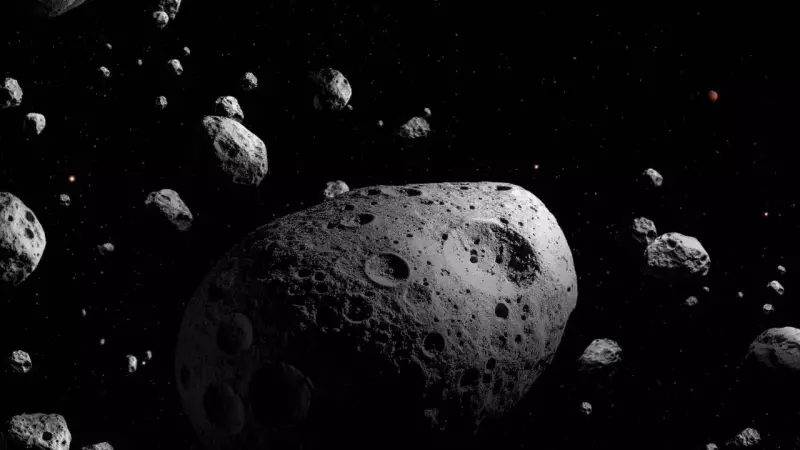
In a discovery that has stunned astronomers and rewritten textbooks, a massive asteroid has been found spinning at a speed so extreme it should have torn itself apart. The identification of asteroid 2025 MN45 marks a historic milestone, proving that the universe still holds profound surprises for modern science.
Record-Breaking Discovery from a New Eye on the Sky
The groundbreaking find was made during the early commissioning phase of the Vera C. Rubin Observatory, a project of the NSF and DOE. While testing its systems, the observatory's powerful instruments detected nearly 1,900 new asteroids in a short window. One object, however, immediately stood out: 2025 MN45.
This asteroid completes a full rotation every 1.88 minutes, making it the fastest-spinning object of its size ever detected. The discovery was first announced at the Rubin Observatory's First Look event in June 2025 and later detailed in a peer-reviewed study published in The Astrophysical Journal Letters.

The Giant Camera That Made It Possible
This achievement was powered by the Rubin Observatory's LSST Camera, the largest digital camera ever built for astronomy. With an incredible 3,200 megapixels coupled with an 8.4-meter mirror, this camera can capture rapid, high-resolution images of the night sky.
Over seven nights of observations between April and May 2025, scientists tracked the subtle changes in MN45's brightness. This data allowed them to calculate its astonishing spin rate. This study is the inaugural peer-reviewed scientific paper to use data from the LSST Camera, showcasing its revolutionary ability to observe changes in the time domain with unprecedented clarity.
The Puzzling Mystery of a Spinning Giant
The real shock lies in the asteroid's size. Asteroid 2025 MN45 is estimated to be about 710 metres in diameter. Until now, scientists believed that objects larger than 500 meters had a natural rotational speed limit, as the centrifugal forces at higher speeds would fling them apart.
Most large asteroids are thought to be "rubble piles"—loose collections of rock and dust held together weakly by gravity. At MN45's rotation speed, such a structure would disintegrate. Therefore, scientists conclude that this asteroid must possess cohesive strength comparable to solid rock. This finding defies conventional models of asteroid formation and suggests that some large space rocks are far more robust than previously imagined.
What This Means for Our Solar System's Story
The extreme rotation of an asteroid like 2025 MN45 acts as a cosmic fingerprint, holding clues to violent events billions of years in the past. Its spin could be the result of:
- Ancient, high-energy collisions.
- Complex gravitational interactions.
- A breakup from a larger parent body.
Analyzing this asteroid provides a valuable window into the chaotic and violent processes that shaped our young solar system. The discovery also heralds the beginning of a new era. The decade-long survey planned by the Vera C. Rubin Observatory promises to uncover many more such extraordinary objects, fundamentally changing our understanding of the cosmos lurking in our celestial backyard.






