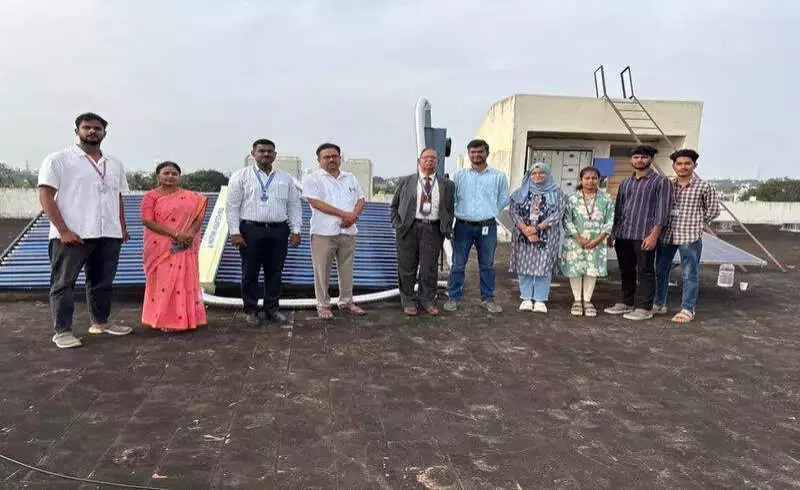
In a remarkable feat of innovation, students and faculty members at the Bapuji Institute of Engineering and Technology (BIET) in Davangere, Karnataka, have pioneered a method to tackle water scarcity by extracting pure water directly from the wind.
The Genesis of a Novel Idea
The project was born four months ago from a simple yet profound observation. Professor Sreenivasa BR, the PG coordinator of the Computer Science and Design department, was inspired while reading a novel that highlighted the acute water shortages in forests globally. He theorized that extracting moisture from the air could significantly address this issue. Despite being from a computer science background, he mobilized a team of five dedicated students to bring this idea to life.
"We consulted Maitra Aquatic for technical support and submitted a proposal for funding," explained Prof. Sreenivasa. They sought Rs 5 lakh under the state government's New Age Innovation Network (NAIN) 2.0 scheme. The government sanctioned Rs 3 lakh, and the college management contributed an additional Rs 1 lakh, providing the necessary financial backbone for the project.

How the Atmospheric Water Generator Works
The team's current setup is a testament to ingenuity and cost-effective engineering. Initially planning to use expensive hydro panels, they pivoted to a more affordable solar panel that generates 2 KW of electricity daily. This solar power is crucial for the condensation process.
The core technology involves installing condensers on blowers. Air desiccant beds containing silica gel are placed inside these blowers to absorb moisture from the atmosphere. The absorption cycle runs from evening to morning. Subsequently, the solar-generated power provides the heat needed during the daytime to condense this absorbed moisture into liquid water.
"We spent about 10 days on the fabrication work," noted the professor. The system is now capable of producing an impressive 10 litres of water per day.
Purity That Surprised Even the Creators
Perhaps the most astounding result was the quality of the water produced. The team created two samples—filtered and unfiltered—and sent them for testing within their college laboratory. The findings were exhilarating.
"We were thrilled to know that the unfiltered water was as good as the filtered one," shared Prof. Sreenivasa. The condensed water contained all necessary minerals and registered a pH value between 4 and 8, meeting purity standards. In fact, the team claims the collected water is purer than standard purified water.
Encouraged by fantastic results during the rainy season, the team now plans to focus on absorbing "seasonal water" to optimize yield year-round.
Hands-On Experience and Future Prospects
The student team, comprising Rida Ajmayeen, Roopa S, Sandesh Gowda MN, Shashank JK, and Vayuputra Raj Urs, gained invaluable practical experience. They were deeply involved in mobilizing resources, operating the devices, and understanding the local fabrication process.
The institute's leadership expressed immense pride in this achievement. BIET Director Y Vrushabhendrappa and Principal HB Aravinda commended the faculty and students for their innovative spirit. They also revealed that experts from IIIT Dharwad are expected to visit the campus soon to review the project, which could lead to further development and scaling.
This project from BIET Davangere stands as a beacon of sustainable innovation, offering a promising, renewable solution to the pressing global challenge of water scarcity by literally making water out of thin air.