

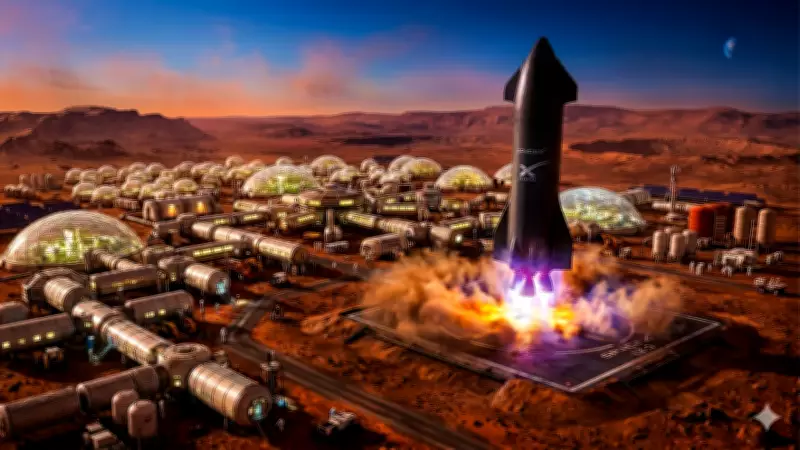
Elon Musk, the world's richest person and soon-to-be first trillionaire, has set his sights beyond Earth. The SpaceX founder envisions not just visiting Mars but establishing a permanent human settlement there, turning humanity into a multi-planetary species. As Musk puts it, the goal is to "make life multi-planetary so that we can expand the scope and scale of consciousness… and ensure the long-term survival of civilization."
This dream has been Musk's obsession since the early 2000s, driven by the belief that Earth is fragile and needs a backup. He sees Mars as "life insurance" for humanity, a refuge in case of a planetary catastrophe. However, the reality is harsh: Mars is cold, dry, and utterly inhospitable. Survival requires reliable systems for air, food, energy, and shelter. A single failure could doom the mission.
The Starship System: Key to the Dream
SpaceX is building the most powerful launch system ever: the Starship-Super Heavy stack. The fully integrated vehicle stands up to 142 meters tall and can lift 100–150 tonnes to orbit. It consists of two stages:

- Super Heavy Booster: Designed to be recovered mid-air by the launch tower's mechanical arms ("Mechazilla").
- Starship Upper Stage: The interplanetary vessel for cargo and crew.
The Raptor engine, using a full-flow staged combustion cycle, burns liquid methane and liquid oxygen. Methane was chosen because it burns cleanly and can be produced on Mars via in-situ resource utilization (ISRU), enabling return missions.
Orbital Refueling: A Critical Hurdle
Starship cannot carry enough fuel for a round trip. It must be refueled in orbit by 8 to 14 tanker Starships. This involves transferring cryogenic methane and oxygen in zero gravity, a challenge due to rapid boil-off. If orbital refueling fails, the Mars architecture collapses.
The Journey and Landing
Missions launch during Hohmann transfer windows every 26 months, with a six-to-nine-month voyage. Upon arrival, Starship must survive atmospheric entry at 7.5 km/s. Mars' thin atmosphere renders parachutes ineffective, so Starship uses a "belly flop" maneuver, flipping upright for a powered landing.
Testing Progress
SpaceX's iterative approach has seen steady progress:
- 2023: IFT-1 ended in self-destruct; IFT-2 achieved hot-stage separation but both stages failed.
- 2024: IFT-3 reached space; IFT-4 had controlled splashdowns; IFT-5 achieved the first booster catch by Mechazilla.
- 2025–2026: Focus on reuse, engine restarts, and heat shield improvements, but upper-stage issues persist.
Plans for uncrewed Mars missions have shifted to 2028, with crewed missions possible in 2030–31.
Major Challenges
Landing Heavy Spacecraft
Mars' thin atmosphere complicates landing 50–100 tonne vehicles. Inflatable decelerators and supersonic retropropulsion are unproven at scale.
Fuel Production on Mars
Producing methane via the Sabatier reaction (CO₂ + 4H₂ → CH₄ + 2H₂O) requires megawatt-scale nuclear reactors, not yet available.
Radiation Exposure
Galactic cosmic rays and solar radiation increase cancer risk and cognitive damage during the journey and on Mars.
Life Support Reliability
Oxygen and water recycling must work flawlessly for years; any failure could be fatal.
Human Health and Isolation
Microgravity causes muscle and bone loss; Mars' low gravity poses long-term health risks. Psychological isolation is severe, with communication delays of 4–24 minutes and blackouts during solar conjunction.
Unproven Technologies
Key systems like large-scale life support and orbital refueling remain unproven. Experts warn that even small settlements may take decades longer than Musk's optimistic timelines.
While Musk's vision is inspiring, the path to Mars is fraught with immense technical, biological, and logistical hurdles. Success is far from guaranteed, but SpaceX's relentless testing keeps the dream alive.






