

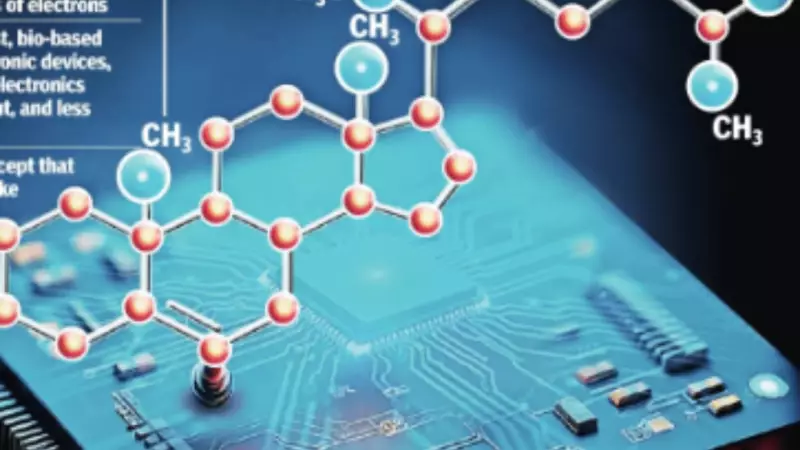
In a surprising twist that bridges biology and technology, a team of Indian scientists has discovered that cholesterol, a molecule synonymous with heart health, could become a crucial component in the next generation of electronics. Researchers from the Institute of Nano Science and Technology (INST) in Mohali have demonstrated that this waxy substance can precisely control a fundamental property of electrons known as 'spin', opening doors to faster, more efficient, and potentially biodegradable devices.
From Heart Health to High-Tech: Cholesterol's New Role
Modern computers and smartphones operate by manipulating the electrical charge of electrons. However, electrons also possess another intrinsic property called spin, which conventional electronics completely ignore. The emerging field of spintronics aims to harness both the charge and the spin of electrons to create a new paradigm of devices.
The team at INST Mohali — comprising Amit Kumar Mondal, Rabia Garg, Pravesh Singh Bisht, Nidhi Bhatt, and Nagaraju Nakka — found that cholesterol molecules provide a natural and effective way to filter and control electron spin. This breakthrough hinges on a concept called chirality, or 'handedness'. Like a left-handed glove that doesn't fit the right hand, cholesterol molecules have a specific chiral structure.

Nature's Blueprint for Spin Control
The scientists engineered large molecular structures where cholesterol molecules stack together in helical, spiral-like arrangements, held together by metal ions. These structures form naturally, similar to DNA's double helix. The key discovery was that by changing the type of metal ion used, they could reverse the direction of the helix's twist.
By adding zinc ions, electrons spinning in one direction flowed through easily. When they switched to copper ions, the preference flipped, allowing electrons with the opposite spin to pass. This is akin to changing the handrail on a spiral staircase and forcing everyone to climb in the opposite direction.
The level of control achieved is remarkably high. The researchers recorded spin polarisation values as high as 87%, meaning nearly nine out of every ten electrons emerging from their cholesterol-based material had the desired spin orientation. These measurements were conducted using sophisticated nanoscale instruments that track current flow under magnetic fields.
A Future of Instant Devices and Sustainable Tech
The implications of this research are profound. Spintronic devices could function like paper files that retain information without constant power, unlike today's volatile computer memory. This could mean:
- Laptops and phones that boot up instantly.
- Devices that remember exactly where you left off, even after the battery dies.
- Massive reductions in heat generation and power consumption for data centres, leading to lower electricity costs and carbon emissions.
- More efficient medical implants, smartwatches, and electric vehicle systems that run longer on smaller batteries.
Currently, the work exists in thin films just nanometres thick under laboratory conditions. However, scaling this technology could lead to electronics that are not only more powerful but also flexible, biodegradable, and even self-healing. Imagine wearable health sensors that mould to your skin or electronic components that decompose safely after use.
This research represents a significant step in the convergence of biology and electronics. Just as solar technology drew inspiration from photosynthesis, spintronics is now borrowing from molecular chirality. In a pleasing irony, the molecule often linked to health concerns may one day be responsible for creating leaner, faster, and more sustainable technology for the world.






