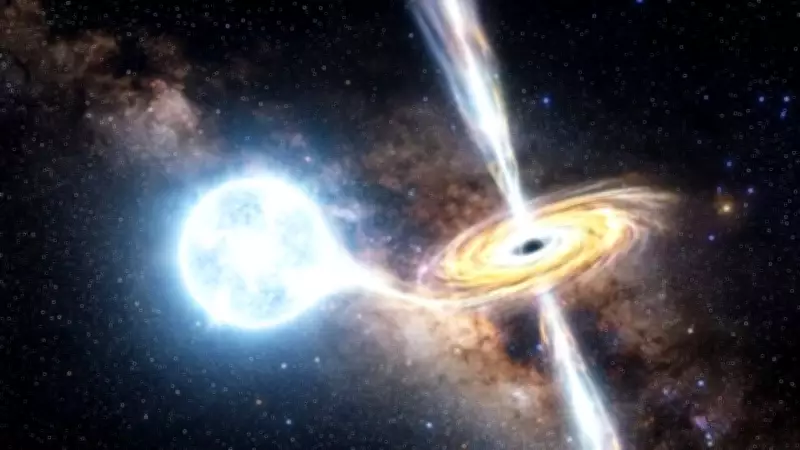
Cygnus X-1 Black Hole Study Reveals How Jets Channel Energy Across Universe
For more than six decades since its groundbreaking discovery, Cygnus X-1 has stood as the first black hole ever confirmed to exist, consistently yielding fascinating and crucial scientific insights. Recent breakthroughs from this celestial object have unveiled remarkable details about the immense power of its jets, fundamentally advancing our understanding of black hole physics and their cosmic influence.
Decades of Radio Telescope Data Uncover 'Dancing' Jet Mechanism
A comprehensive study conducted at Oxford University has compiled an extensive collection of 18 years' worth of radio-telescope observations from the Cygnus X-1 binary system. This unprecedented dataset provides scientists with compelling evidence of what researchers describe as a 'dancing' jet mechanism. The powerful stellar winds emanating from the supergiant companion star within the system actively alter the shape of the jets as they stream away from Cygnus X-1.
The analysis reveals these jets generate energy equivalent to the staggering luminosity of 10,000 Suns while traveling at approximately half the speed of light. Published in the prestigious journal Nature Astronomy, this research offers empirical validation for long-standing theoretical models about how black holes channel energy to influence galaxy formation throughout the cosmos.

Cygnus X-1: The Prototype Black Hole System
Cygnus X-1 represents a binary system containing a black hole with a mass approximately 21 times that of our Sun, paired with a massive supergiant star. Since the 1960s, this system has served as the fundamental prototype for black hole research worldwide. Astronomers have historically faced significant challenges in measuring the instantaneous jet power from black holes, often relying on long-term averages that fail to capture dynamic variations.
By utilizing archival data and accounting for physical distortions caused by the companion star's wind, lead author Dr. Steve Raj Prabu from the University of Oxford's Department of Physics has made a groundbreaking determination. Approximately 10 percent of the energy from material falling into the black hole gets channeled directly into these extraordinarily powerful jets, a finding that revolutionizes our comprehension of black hole energy distribution.
Using Stellar Winds as a Cosmic Measurement Tool
The research team developed an innovative approach by treating the companion star's powerful winds as a 'cosmic scale' for measurement. As the two objects orbit each other every 5.6 days, the stellar wind blows against the jets, causing them to bend and creating what appears as a dancing motion. Astronomers leveraged this deflection phenomenon to precisely measure jet strength on an astronomical scale.
The measurements confirm ejection speeds of about 150,000 kilometers per second, equivalent to roughly half the speed of light. These findings validate several critical theories regarding how black holes release energy and redistribute it into the surrounding interstellar medium, providing concrete data where previously only speculation existed.
Shaping Future Models of Galactic Evolution
This research establishes what astrophysicists describe as an essential 'anchor point' for future studies. Since black hole accretion physics operates on similar principles regardless of scale, the precise measurements obtained from Cygnus X-1 can now be used to calibrate simulations of supermassive black holes, which are millions to billions of times more massive.
Astronomers are preparing to apply these novel measurement techniques to identify and quantify jets from numerous distant galaxies using data from the upcoming Square Kilometre Array (SKA) project. This ambitious international endeavor will help construct a more complete picture of how black holes generate cosmic shocks and turbulence, ultimately contributing to our understanding of the Universe's structural evolution.
The Cygnus X-1 study represents a monumental leap forward in astrophysics, transforming how scientists perceive black hole energetics and their profound impact on cosmic development across billions of years.