

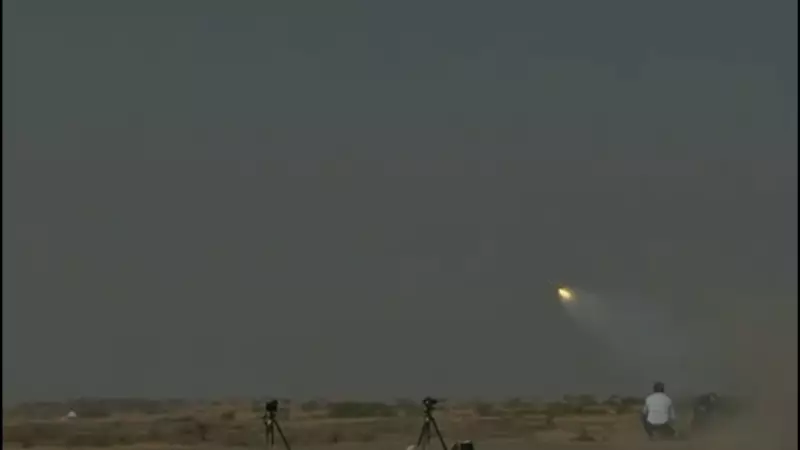
In a significant boost to India's defence indigenisation efforts, Defence Minister Rajnath Singh on Monday lauded the successful flight test of a domestically developed advanced anti-tank missile. The test marks a crucial milestone for the 'Aatmanirbhar Bharat' (self-reliant India) initiative in the strategic defence sector.
Details of the Successful Missile Test
The Third Generation Fire & Forget Man Portable Anti-Tank Guided Missile (MPATGM) featuring a top attack capability was put through its paces. The critical trial took place on January 11 at the KK Ranges in Ahilya Nagar, Maharashtra. The missile successfully engaged and hit a moving target, validating its combat readiness.
The test was conducted by scientists from the Defence Research and Development Laboratory (DRDL) in Hyderabad, which operates under the Defence Research and Development Organisation (DRDO). In a post on social media platform X, the defence minister's office confirmed the success and shared the minister's commendation for the teams involved.

Advanced Indigenous Technologies Powering the MPATGM
This indigenously developed weapon system is a technological marvel, integrating several cutting-edge Indian-made components. Key systems include:
- An Imaging Infrared (IIR) homing seeker for precision targeting.
- An all-electric control actuation system for guidance.
- A sophisticated fire control system.
- A powerful tandem warhead designed to penetrate modern armour.
- An indigenous propulsion system.
- A high-performance sighting system.
The development was a collaborative effort across multiple DRDO laboratories nationwide. The Research Centre Imarat (Hyderabad), Terminal Ballistics Research Laboratory (Chandigarh), High Energy Materials Research Laboratory (Pune), and Instruments Research & Development Establishment (Dehradun) all contributed critical technologies. The Defence Laboratory in Jodhpur provided the Thermal Target System to simulate a tank for the test.
The Imaging Infrared seeker grants the missile day-and-night operational capability, making it a formidable all-weather weapon. It can be launched from a portable tripod or from a vehicle-mounted launcher, offering tactical flexibility to infantry units.
Path to Induction and Strategic Significance
The successful test paves the way for the missile's eventual induction into the Indian Army, enhancing the force's anti-armour capabilities. Defence production partners Bharat Dynamics Limited (BDL) and Bharat Electronics Limited (BEL) are integral to the project's development-cum-production phase.
Rajnath Singh extended his congratulations to the DRDO, the DcPP partners, and the wider defence industry, reiterating that this achievement is a vital stride towards self-reliance in defence. Dr. Samir V Kamat, Secretary of the Department of Defence R&D and Chairman of DRDO, also praised the team, confirming the test's success and its importance for the weapon's future deployment.
This accomplishment underscores India's growing prowess in designing and manufacturing complex, next-generation weapon systems, reducing dependency on foreign imports and strengthening national security.






