

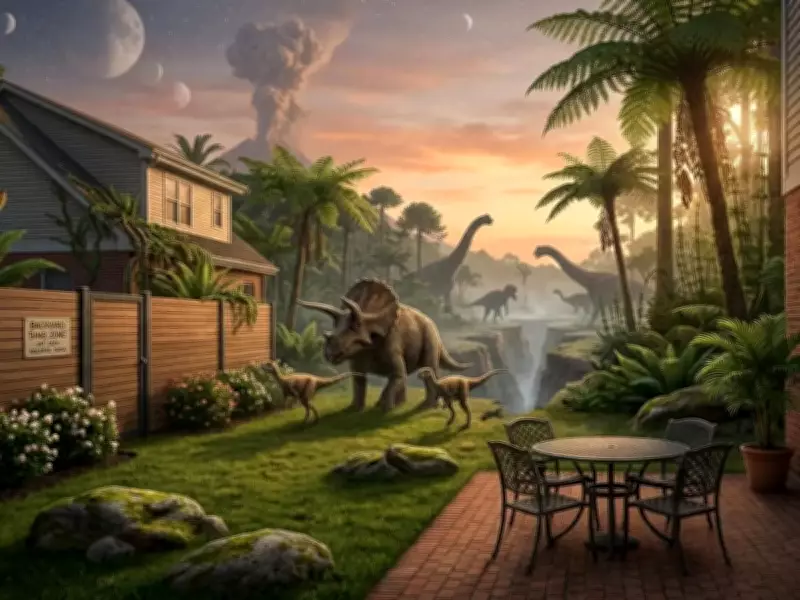
A new online tool is captivating users by allowing them to explore where their home or city was located on Earth millions of years ago, during the time of the supercontinent Pangea. While NASA's interactive tool that spells out names using satellite images went viral, this resource offers a deeper dive into our planet's geological past.
Understanding Earth's Ancient Geography
Published in the journal PLOS One, researchers have enhanced Paleolatitude.org, a tool that shows how any spot on Earth appeared at various times over the last 230 million years. It relies on the Utrecht Paleogeography Model, which illustrates continental drift from ancient times to the present. Users can enter a location to see how its latitude evolved over geological eras.
Why Latitude Matters
Latitude is a critical factor in Earth sciences, influencing climate, ecosystems, and biodiversity. A region near the equator differs drastically from one near the poles. This tool helps scientists examine ancient environments and understand how they impacted organisms, allowing fossils to be analyzed not only by age but also by geographic location.

Emilia Jarochowska, a paleontologist at Utrecht University, noted that this method gives researchers greater confidence in exploring various factors. She highlighted that knowledge of biodiversity has evolved from one-dimensional to three-dimensional, incorporating spatial dimensions thanks to this technology. Specialists can now better link research on climate, geography, and life evolution.
Real-World Application: Solving a Mystery
The tool has already resolved a long-standing mystery. Fossil evidence from Winterswijk, Netherlands, estimated at 245 million years old, indicated a warm, dry climate similar to the Persian Gulf today. However, this contradicted its current location in Northern Europe. Using the model, scientists proved that the site was much closer to the equator at that time, corresponding to regions like modern-day Arabia. This example illustrates how continental drift affects scientific conclusions.
How Paleolatitude.org Works
The enhanced platform integrates geological and paleomagnetic data, which tracks changes in Earth's magnetic field. It accounts for both continental motion and magnetic pole shifts, yielding more precise results than previous tools. Users can export graphs, analyze datasets, and upload data for bulk calculations. While the latter is primarily for scientists, the user-friendly interface makes it accessible to anyone.
Mapping Past Biodiversity Hotspots
Another major application is understanding historical biodiversity patterns. In their study, researchers analyzed around 34,000 fossilized marine species from the Late Jurassic epoch. Latitude calculations allowed them to map regions where biodiversity flourished. Advanced techniques like bootstrapping quantified uncertainties in the data. Jarochowska emphasized that they can now create a clearer picture of past biodiversity, understand post-mass-extinction changes, and identify uninhabitable regions versus biodiversity hotspots.
Implications for the Modern World
Knowledge of past climate change and biodiversity helps address today's environmental issues. Studying species' responses to ancient warming or cooling can predict future trends. The model also identifies areas that served as refuges during environmental changes, aiding conservation efforts. Scientists are extending the model to trace history back to the Cambrian explosion, about 550 million years ago.
A Small Tool with a Big Picture
Paleolatitude.org offers a new perspective on our current location relative to Earth's long geological history. Any place—a backyard, city, or natural monument—can be tracked through millions of years of plate tectonics. It simplifies complex science into an interactive experience, reminding us that the land we stand on was once somewhere else.






