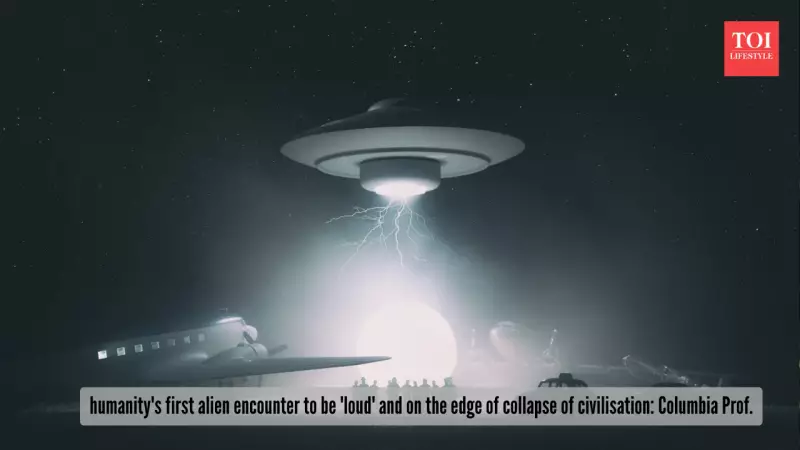
For decades, science fiction has painted vivid pictures of alien encounters, from epic invasions to benevolent meetings. However, a leading astronomer suggests reality will be far more dramatic and unsettling. According to a new theory, humanity's first 'hello' from the cosmos is likely to be a deafening death cry from a civilization on the brink of collapse.
The Eschatian Hypothesis: Why First Contact Won't Be Peaceful
Dr. David Kipping, an astrophysicist who leads the Cool Worlds Lab at Columbia University, has proposed a compelling and sobering idea. In a study prepared for the Monthly Notices of the Royal Astronomical Society and explained in a YouTube video, he presents the 'Eschatian Hypothesis.' This theory argues that our first confirmed detection of alien intelligence will not be from a stable, advanced empire, but from a rare, extreme, and 'loud' example.
"Hollywood has preconditioned us to expect one of two types of alien contact, either a hostile invasion force or a benevolent species bestowing wisdom to humanity," Kipping stated. His hypothesis breaks from this binary view. He draws a parallel to how we observe stars: about a third of the stars visible to the naked eye are evolved giants, even though less than one percent of stars are actually in that state. We see them because they are exceptionally bright.

By the same logic, the alien signals or 'technosignatures' we detect first will be the cosmic equivalents of these giants: highly atypical, transient, and incredibly powerful. Kipping suggests this could mean detecting signs from a society experiencing a cataclysmic event, such as a global nuclear war, which broadcasts massive, detectable signals as a final act.
Listening for the Cosmic Death Rattle
What would such a 'loud' signal look like? It wouldn't necessarily be a deliberate message of peace. Instead, it could be the unintended byproduct of a civilization's final moments. Kipping speculates that such a society might 'consciously send out messages into the void as a kind of last-ditch resort,' having 'nothing to lose.'
This doesn't mean every powerful signal is a sign of doom, but indicators like extreme planetary pollution or evidence of rapid climate change on another world could point to inherent instability. The key is that these events create signatures bright enough to cross the vast interstellar distances and be noticed by our telescopes.
Kipping's theory gains context amid ongoing discussions about interstellar objects. He references the buzz around 3I/ATLAS, an interstellar comet that passed near Earth. While NASA classifies it as a natural object, Harvard astronomer Avi Loeb has pointed out its unusual traits, suggesting it could be an artificial probe. This debate underscores the need for vigilant sky surveys.
The Search for Fleeting Signals
To catch these potential 'death throes' of civilizations, Dr. Kipping urges astronomers to prioritize wide-sky surveys that can detect transient, fleeting signals. Upcoming facilities like the Vera Rubin Observatory are perfectly suited for this task, as they will continuously scan large portions of the sky for short-lived cosmic events.
The implication is profound: if the Eschatian Hypothesis holds true, our inaugural conversation with another intelligence might be a one-sided eavesdropping on a tragedy of galactic scale. It shifts the search for extraterrestrial life (SETI) from looking for deliberate, steady beacons to also monitoring for catastrophic, brilliant flashes that tell a story of a civilization's end. This prepares us for a first contact that is less about wisdom and more a stark warning from the stars.