

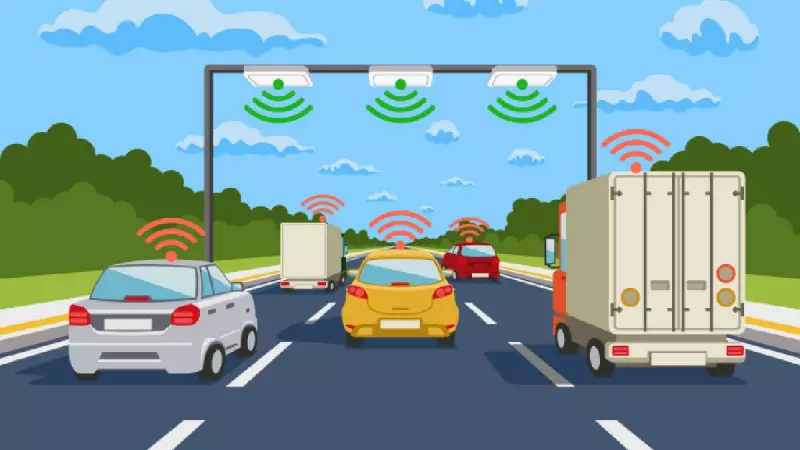
In a landmark move aimed at drastically improving road safety, Union Minister for Road Transport and Highways, Nitin Gadkari, has announced a mandate for advanced vehicle-to-vehicle (V2V) communication technology. This initiative, set to be enforced from 2026, will require all new vehicles sold in India to be equipped with systems that allow them to 'talk' to each other wirelessly.
What is V2V Communication and How Will It Work?
Vehicle-to-vehicle communication is a cutting-edge safety technology that enables automobiles to exchange critical data in real-time. Using a dedicated short-range communication (DSRC) protocol, similar to a Wi-Fi network, cars will share information such as their speed, direction, braking status, and position. This exchange happens within a range of a few hundred meters, creating a dynamic awareness network on the road.
For instance, if a vehicle several cars ahead suddenly applies hard brakes, a warning signal will be instantly relayed to the following vehicles, alerting their drivers even before they see the brake lights. This system is designed to function in all visibility conditions, potentially preventing chain-reaction collisions, especially in fog, heavy rain, or at blind corners.

The Government's Roadmap for Implementation
The announcement was made by Nitin Gadkari at an event in New Delhi. The minister set a clear and ambitious timeline for this technological overhaul. Starting from 2026, all new vehicles manufactured and sold in the country will be required to have this V2V communication feature integrated. This mandate is a part of the government's broader strategy to leverage technology for saving lives on Indian roads.
Gadkari linked this mandate to the upcoming Bharat NCAP (New Car Assessment Programme), India's own vehicle safety rating system. He indicated that the inclusion of V2V technology would be a significant factor in achieving higher safety ratings under this program. This creates a strong incentive for manufacturers to not only comply but to excel in implementing these systems effectively.
Ambitious Target: An 80% Reduction in Accidents
The primary goal behind this sweeping mandate is to achieve a monumental reduction in road accidents. Minister Gadkari stated that the government aims to cut road accidents and associated fatalities by a staggering 80% through the deployment of this technology. India has one of the world's highest numbers of road accident deaths, and this move is seen as a potential game-changer.
The V2V system addresses the critical issue of reaction time. By providing drivers with advanced warnings about hazards they cannot yet see, it effectively extends their perception and gives them precious extra seconds to react appropriately. This proactive safety net is expected to mitigate a vast majority of collisions caused by human error or delayed responses.
The government's push for V2V technology represents a significant leap towards intelligent and connected mobility in India. While challenges related to standardization, cost, and phased implementation remain, the 2026 deadline sets a clear direction for the automotive industry. This policy, coupled with other safety measures like Bharat NCAP, underscores a firm commitment to making Indian roads safer for everyone.






