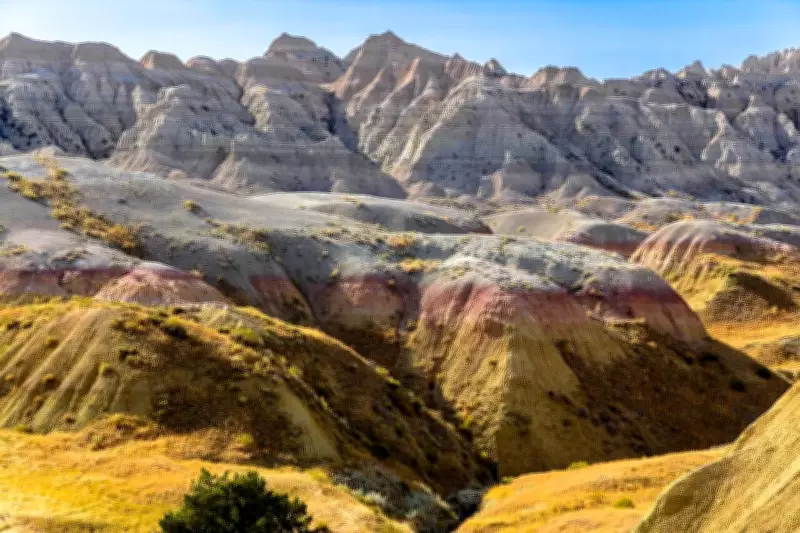
The natural world possesses an extraordinary capacity to conceal entire ancient realms beneath our feet, revealing them only at the precise moment. In the summer of 1994, two hikers, Steve Gasman and Jim Carney, were exploring the intricate canyons of Badlands National Park in South Dakota. While walking along a dirt path near the Conata Picnic Area, they encountered massive bones protruding from the ground.
A Perfect Response
The hikers acted with exemplary caution. Instead of attempting to excavate or remove the fragile remains themselves, they recorded the coordinates and promptly notified park authorities of their find. When professional paleontologists arrived to investigate, they realized that this was no ordinary discovery. The observant travelers had uncovered one of the most significant citizen-led fossil discoveries in the region, sparking years of intensive research.
Unearthing a Prehistoric Catastrophe
What began as a weekend stroll evolved into decades of extensive excavation, known as the Big Pig Dig. According to the NPS Geodiversity Atlas—Badlands National Park, the park's distinctive landscape cuts through Oligocene deposits rich in mammalian fossils. Over fifteen consecutive field seasons, teams worked tirelessly to remove sediment, revealing a staggering collection of over 19,000 fossils. These included hornless prehistoric rhinos, diminutive horses, and massive carnivorous pigs.

The density of fossils indicates that this site was not merely a burial ground. Taphonomy—Death & Decay analysis suggests that the disarticulated skeletons represent an ancient, desiccated watering hole. Approximately 34 million years ago, a severe drought forced diverse animal species to congregate around the last remaining water source. Weakened by drought, hundreds of creatures became trapped in the muddy ground, creating a fossil record that offers crucial insights into ancient environmental changes.
Preserving Ancient History
The study of this site has provided valuable information about ancient climate shifts. According to an article in Scientific Reports, ancient waterways often served as ecological centers where stories of animal stress, climate change, and survival were preserved in stone. Today, the recovered fossils are examined in public laboratories, offering visitors a glimpse into the past. The excavation's legacy highlights how erosion continuously rewrites history.
Even as we hike through rugged state parks or take family road trips, deep history lies beneath our feet. This discovery proves that important finds do not require corporate funding; sometimes, all it takes is a pair of observant eyes during a casual walk. The fact that an afternoon trek by two tourists unveiled a 34-million-year-old ancient watering hole, bringing it from obscurity into the annals of paleontology, is truly awe-inspiring.