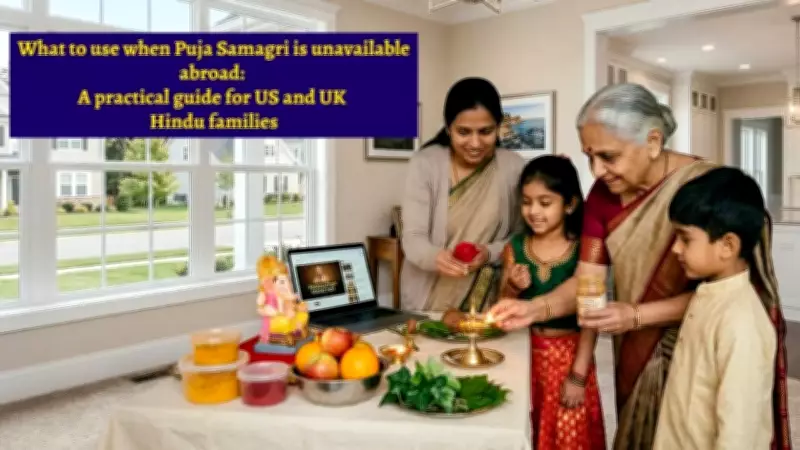
You do not need to abandon the puja because one item is missing. That is the first thing many Hindu families in the US and UK need to hear. You are not being careless. You are dealing with a Tesco run that did not have fresh betel leaves, a New Jersey apartment where an open flame feels risky, a child's school pickup at 3 pm, and a temple that may be forty minutes away if traffic behaves. The pressure is real, especially when elders back home can list every item in the thali from memory.
But honesty is still important. There is a difference between what the tradition requires, what your family members have always done, and what you are doing in other countries so that the ritual can be carried out with respect.
Know Which Category Your Substitution Belongs To
Before swapping anything, make sure you sort the missing item into three buckets.

Canonical ritual is when the object or action is a part of an exact puja vidhi, ritual, your sampradaya, tradition, or lineage you adhere to. If a priest advised your family members that a certain donation is necessary for a particular fire ritual, homa, or vrata, which is a sacred observance, you should not assume that a substitute is always acceptable.
Family custom refers to the item being a part of the way your family has been worshipping for centuries, however it is not required in all religions. Maybe your grandmother always offered misri, rock sugar, to Krishna, or always used marigolds on Fridays. It is important, however it is not identical to a scriptural requirement.
Pragmatic adaptation in another country means that you are making a thoughtful modification because the original item is not available, restricted, too expensive, or unsuitable for the place you live. This is common. It is not a failure. It is also not the same as saying, “This substitute is universally valid in every sampradaya.” That distinction protects both devotion and honesty.
When Flowers Are Limited, Offer What Is Fresh and Clean
Fresh flowers are one of the most common problems abroad. In many US and UK towns, you will not find marigold, jasmine, or lotus on an ordinary weekday. Even Indian grocery stores may only have flowers around major festivals.
An alternative is any freshly cut, unsprayed flowers that are available locally, offered with attention. Carnations, chrysanthemums, roses, and even supermarket mix flowers are often used in diaspora households. If you can only find petals, you can use them. If flowers are not available on the day, certain families provide akshata, which is rice that has not broken, typically mixed with turmeric instead of flowers in nama archana, the recitation of names of God. However, confirm this with the family tradition of your family.
Artificial flowers are often used to decorate the altar, however they are not the same as fresh flowers in all ceremonies. Keep the distinction in mind.
No Mango Leaves? Work with What Your Household Can Source
Mango leaves are widely used for kalasha, the sanctified vessel, and doorway decoration. They can be hard to find in London suburbs or smaller American cities, and importing plant material can raise legal issues.
If your priest or family permits it, use clean local leaves from a non-toxic plant, or omit the decorative leaf element and keep the kalasha itself properly prepared. Some traditions accept simple adaptation here, because the kalasha's meaning, invoking auspicious presence, is carried by the vessel, water, and sankalpa, the stated intention. Others are stricter.
Do not pluck random leaves from public landscaping or unknown plants. That is not devotion, that is guesswork.
For Gangajal, Use Clean Water and State Your Intention
Gangajal, water from the Ganga, carries deep emotional and ritual value for many families. Some homes keep a small bottle for years, using a few drops at a time. If you own it, utilize it. If you do not, do not panic.

A practical option is clean potable water, ideally filtered, placed in a dedicated puja vessel. Some families add a drop of previously stored Gangajal if available. If not, use the water you have and offer it with reverence. As per some traditions, sanctification through mantra recitation is accepted for home worship when Gangajal is unavailable. For temple-level or highly formal rituals, ask your priest first.
This is one of the clearest diaspora adaptations. It preserves the purpose, purification and offering, without pretending your tap water is literally Ganga water.
Fruit Offerings Can Be Local, Seasonal, and Simple
You do not need imported Indian fruit for naivedya, a food offering to gods. Bananas are popular because they are simple to find, however apples, pears, berries, grapes, plums, and oranges are all used in diaspora homes. Offer clean vegetarian food that your tradition permits.
The most important factor is cleanliness, freshness, and appropriateness for the god and the occasion. For instance, some families do not consume certain foods on days of fasting. On Ekadashi, the eleventh lunar day observed by many Vaishnava and Vishnu-loving households, the rules of fasting differ widely. Some sources that publish 2026 Ekadashi calendars for international readers include local paranas, fast-breaking times by region, which can be beneficial to US and UK families as the break-fast time and date can change depending on the location. But fasting foods and offerings still follow sampradaya and family practice, not a generic internet list.
If Sandalwood Paste Is Missing, Don’t Invent a Random Replacement
Chandan, sandalwood paste, is usually difficult to come across in its pure form outside of India. If you have a bag of sandalwood powder or a puja paste that you can buy from a reputable Indian store, you can use it. If not, it is better to leave it out than use scented creams or perfume.
Kumkum, red-colored ritual powder, and haldi, turmeric, are easy to find and are often sufficient for daily worship when chandan is not present. The premise here is straightforward. Ritual substances cannot be interchangeable simply because they smell good or look attractive.
Betel Leaves and Nuts Are Often Omitted Abroad
Paan leaves, betel leaves, and supari, areca nut, appear in many pujas, but they are not easy to source everywhere. In some UK and US cities with large Indian communities, you can find them in South Asian groceries. In many locations, you are not allowed to.
If they constitute a formal ritual, you can ask your priest for instructions. In many home pujas, families simply omit them when unavailable rather than forcing a poor substitute. A spinach leaf is not a betel leaf. A random nut from the pantry is not supari.
Sometimes the respectful choice is omission, not replacement.
What the Household Altar Needs When Flame Is Difficult
A diya, oil lamp, is a staple in many homes, however the rental market, smoke alarms, dorms, and busy mornings can make a flame difficult to light. If you are able to safely light a small diya for a brief aarti, a ritual gesture of light, then do it. Make sure you supervise it. Use a tray. Remove and clean up cautiously.
If a real flame is not feasible, the majority of diaspora families use an electric lamp for daily routines and reserve a real flame for temple visits.
This is adaptation, not equivalence. An electric lamp helps maintain rhythm. It does not become the same thing as a traditional deepa, sacred lamp, in every ritual setting.
The purpose matters here. Daily remembrance should not collapse because your building rules are strict.
Rice, Turmeric, and Homemade Basics Can Carry a Simple Puja
When a full samagri kit is unavailable, a surprising amount can still be done with a few basics. Unbroken rice, turmeric, kumkum, clean water, fruit, incense if tolerated, and a lamp if safe can support many ordinary home pujas.
Akshata can be made at home by mixing dry rice with a little turmeric and a few drops of water, then drying it. This is common and practical. Homemade panchamrit, a five-ingredient holy mixture, typically includes yogurt, milk, sugar, honey, and clarified butter, ghee, but make sure to check with your family customs because the proportions and methods vary.
Keep the altar clean. Use separate utensils for puja if possible. That consistency often matters more than having twenty rare items once a year.
What Changes and What Does Not
What changes abroad is sourcing, scale, and sometimes timing. You may use local flowers, filtered water, supermarket fruit, a smaller altar, and a puja window that fits around the school run or a hospital shift. You can ask priests using Zoom to lead a sankalpa to Leicester, Edison, or Wembley while grandparents join from Mumbai on WhatsApp.
What is not changing is the need to be clear regarding your customs, the care you take when you prepare the ritual, and the respect you show to the God and your ritual.
A substitute is not automatically scripturally identical to the original item. A family custom is not automatically mandatory for every Hindu home. And a practical adjustment made abroad is not something to be ashamed of.
Ask One Temple, One Elder, and One Priest Before You Stock Up
If your family follows a clear sampradaya, start there. Then check with the local temple you actually attend, not ten conflicting social media clips. In the UK, many mandirs and community groups now answer samagri questions by phone or WhatsApp before festival days. In the US too, larger temples often publish festival guidance online, though details may still be broad.
Ask specific questions. “Can I omit mango leaves for Satyanarayana puja at home?” is better than “What can I substitute for everything?” If you require a priest in another country, look for one who is familiar with the language and culture of your country, Gujarati, Tamil, Telugu, Bengali, North Indian Swaminarayan, Smarta, Vaishnava, Shaiva, and so on. Samagri advice changes with that context.
Keep a small notebook in the puja drawer. Record what your family is willing to accept, what your priest has approved, and what you were forced to leave out the last time. The next festival day will arrive sooner than you think, and it is helpful to know, before shops open, if the apples you have on your counter will suffice.
About the Author
AstroDevam is a premium organisation providing ancient and authentic knowledge of Astrology, Vastu, Numerology, and Innovative Corporate Solutions with a contemporary perspective. AstroDevam, having patrons in more than 100 countries, has been promoted by Achary Anita Baranwal and Achary Kalki Krishnan, who not only have Master's Degrees in Astrology but are engaged in teaching Scientific Astrology, Vastu, and Numerology for more than three decades.