

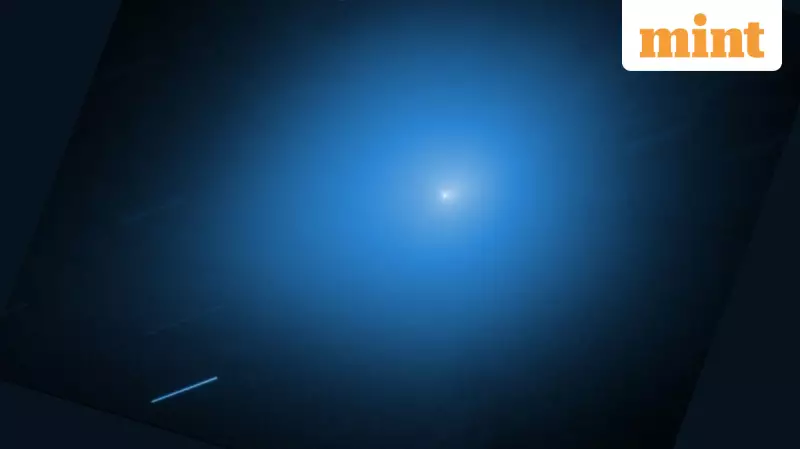
The mysterious interstellar visitor, comet 3I/ATLAS, has captured the attention of astronomers once again. A fresh image from NASA's Hubble Space Telescope, captured on November 30, has provided exciting new confirmation. The image shows the comet is still actively releasing gas and dust, even after its closest approach to the Sun.
What the Latest Observations Reveal
The new Hubble picture presents a clear view of the comet's core. It shows a compact and bright nucleus enveloped by a soft, slightly uneven cloud of gas and dust known as a coma. The background stars appear as streaks in the image because Hubble was carefully tracking the comet's motion across the sky. This trailing effect is a strong indicator that 3I/ATLAS is still active well after its solar flyby.
This comet is a rare scientific treasure. It is only the third confirmed interstellar object ever detected passing through our solar system. Every observation offers scientists a precious opportunity to study the composition and behavior of icy bodies from another star system. Researchers can compare its chemistry and how it reacts to solar heat with comets that originated around our own Sun.

Pinpointing the Comet's Journey
Multiple space missions have collaborated to track this celestial traveler. According to a report by El-Balad, NASA's Psyche spacecraft took multispectral images of the comet back in September. These snapshots have been crucial in refining the comet's precise trajectory and revealing details of its faint outer coma.
From Europe, the European Space Agency's missions have also contributed. For instance, the navigation camera on the JUICE spacecraft detected additional signs of activity as the comet brightened during this observing season. Together, data from deep-space probes and Earth-orbiting telescopes like Hubble give researchers their most complete picture yet of 3I/ATLAS. This allows ground-based observatories to track its path with greater accuracy.
Key orbital facts about 3I/ATLAS include:
- Perihelion: Its closest point to the Sun was measured at about 1.4 Astronomical Units (AU), which is just inside the orbit of Mars.
- Current Location: The comet is now moving away from the Sun, positioned hundreds of millions of kilometers from Earth.
- Closest Approach to Earth: This event is expected to occur around December 19.
How to Spot the Interstellar Visitor
While 3I/ATLAS will not be visible to the naked eye, dedicated sky watchers with a telescope still have a chance to observe this piece of another star system. The best viewing window will be from mid-to-late December, when the comet will be highest in the pre-dawn sky.
As mentioned by El-Balad, the optimal observation times for different regions are:
- North America: Look between 4:00 AM and 6:00 AM Eastern Time.
- UK and Europe: The best time is between 05:00 and 07:00 GMT.
This period, leading up to and just after its closest approach to Earth, offers the best opportunity for amateur astronomers to catch a glimpse of this historic interstellar comet through their telescopes.






