

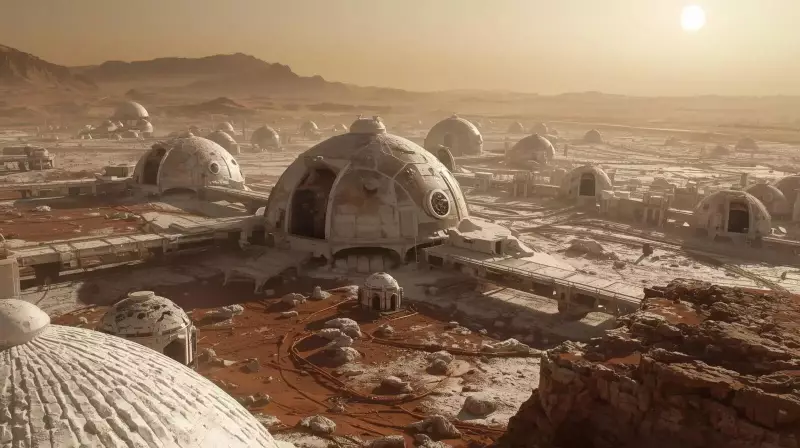
What if the key to building a human civilisation on Mars has been lying on its surface, frozen, for eons? Scientists are now seriously proposing that ice, abundant on the Red Planet, could be the foundational material for future Martian cities, turning a science fiction dream into a potential engineering reality.
From Frozen Water to Future Homes
The dream of establishing cities on Mars has captivated thinkers for generations. However, the planet's harsh environment—bitter cold, lethal radiation, and a thin atmosphere—presents monumental challenges. A groundbreaking idea, presented at a meeting of the American Geophysical Union, suggests a solution might be hiding in plain sight: the planet's extensive ice deposits. Researchers are convinced that this frozen water could be more than just a resource for drinking; it could be transformed into the very walls that protect astronauts.
The logic is compelling for mission sustainability. Future Mars missions can become more practical and less expensive by using local resources, known as in-situ resource utilisation (ISRU), instead of hauling incredibly heavy construction materials from Earth. Mars is estimated to hold over five million cubic kilometres of frozen water, both on and beneath its surface, making it one of the most plentiful materials available to future colonists.

The Triple Threat Shield: Insulation, Radiation, and Light
Ice's potential goes far beyond simple construction. Scientists envision it as a multi-functional marvel.
Firstly, as a superb insulator. Martian temperatures can plunge to a staggering 120 degrees Celsius below zero. Research indicates that an ice wall just a few metres thick could maintain an interior habitat temperature around a more manageable minus 20 degrees Celsius. This natural thermal barrier would protect inhabitants from extreme temperature swings and drastically reduce energy needed for heating.
Secondly, as a radiation blocker. Mars lacks a strong magnetic field and a dense atmosphere, leaving its surface bombarded by cosmic and ultraviolet radiation. Remarkably, ice is an effective shield. Studies show it can block most harmful UV rays while still allowing visible and infrared light to pass through. This means astronauts could be protected without living in perpetual darkness, a critical factor for mental well-being during long missions.
Thirdly, it supports life and light. Ice habitats could be designed to filter harmful radiation while letting in sunlight. This creates an environment suitable for growing plants indoors for food and oxygen. Exposure to natural light would also help regulate circadian rhythms, boosting crew morale.
Significant Hurdles on the Frozen Road
Despite its promise, using Martian ice is fraught with engineering challenges. Extracting enough water to build habitats would be immensely energy-intensive. Estimates suggest a crew would need to process ice from about 15 square metres of Martian ground daily, requiring energy comparable to the daily consumption of the International Space Station. Generating and storing this power on Mars remains a major unsolved problem.
Another issue is durability. Mars is infamous for planet-engulfing dust storms. Dust settling on ice structures could block sunlight, reduce insulation efficiency, and over time, cause the habitat to degrade. Furthermore, ice can slowly sublimate (turn directly into vapour) in Mars' thin atmosphere. Scientists propose applying a protective, moisture-resistant layer, but this would likely need to be brought from Earth, adding to mission complexity.
Nevertheless, the concept of ice architecture represents a realistic and innovative step toward sustainable off-world living. By leveraging materials already present on Mars, researchers are crafting viable pathways to turn humanity's interplanetary ambitions from fantasy into an achievable future.






