

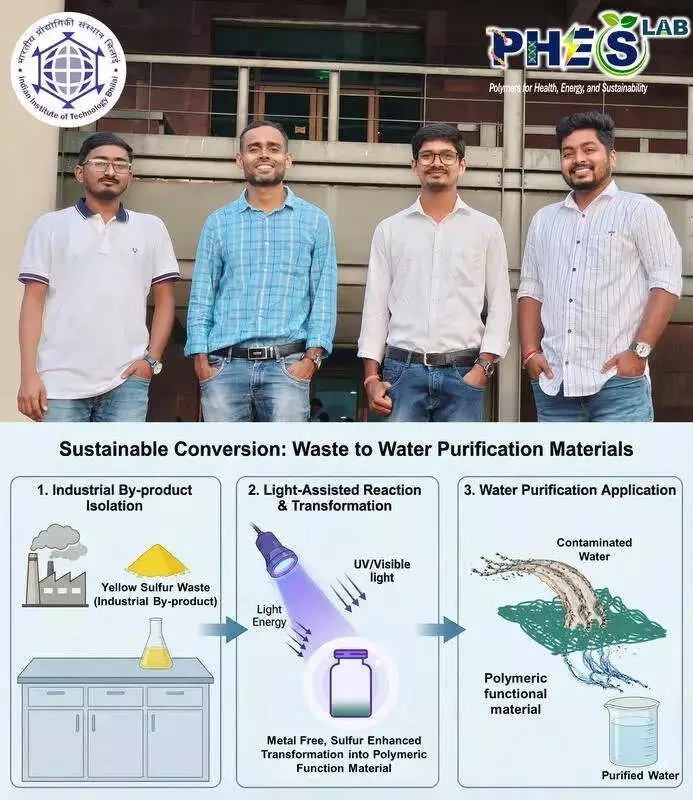
In a development poised to bolster India's fight for clean water, researchers at the Indian Institute of Technology (IIT) Bhilai have achieved a significant scientific feat. They have pioneered a sustainable technology that converts toxic industrial sulfur waste into advanced materials capable of purifying contaminated water.
From Toxic Waste to Green Catalyst
The research team, led by Dr. Sanjib Banerjee and including Bhanendra Sahu, Sudipta Paul, and Priyank Sinha, has developed a metal-free and eco-friendly polymerisation process. This innovative method upcycles low-value sulfur waste—a major byproduct of petroleum refining, coal processing, and chemical manufacturing—into useful sulfur dots, or S-dots.
These S-dots serve as green photocatalysts, which are then used to build next-generation smart polymers. The team's groundbreaking work has been published in the prestigious journal Angewandte Chemie International Edition, highlighting its importance in the fields of materials chemistry and environmental science.

How the Smart Polymer Cleans Water
Using the synthesized S-dots, the researchers created multi-arm star polymers. These polymers have a unique ability to self-assemble into nanoscale spherical structures. In function, these structures act like microscopic sponges designed to target and absorb specific hazardous pollutants.
The material demonstrated a high efficiency in selectively removing hydrophobic pollutants from water. This category includes stubborn industrial dyes, harmful pesticide residues, and oil-based contaminants. Laboratory tests showed promising results, with the polymer platform successfully removing over 80% of these pollutants from contaminated water samples.
A Circular Solution for National Priorities
Dr. Sanjib Banerjee explained that the innovation creates a circular economy solution. It tackles a difficult waste disposal problem by transforming industrial sulfur waste into a clean catalyst, which is then engineered into smart water-purifying polymers.
This breakthrough arrives at a critical time. With water pollution escalating across India due to industrial effluents and agricultural runoff, such technologies are urgently needed. The IIT Bhilai platform aligns perfectly with national missions like the Jal Jeevan Mission and various river rejuvenation projects.
It holds strong potential to enhance wastewater treatment in industrial zones, aid in river cleanup drives, and support broader environmental restoration efforts. The research group is now actively working on scaling up the technology and exploring its integration into real-world water treatment systems, marking a potential game-changer for environmental sustainability in India.






