

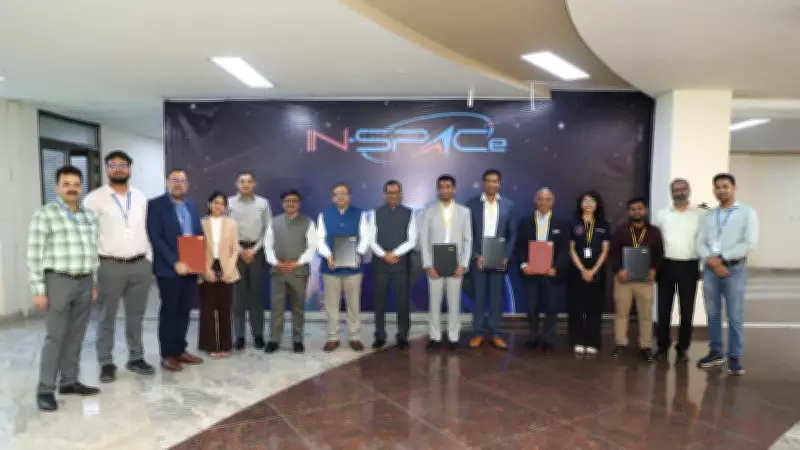
IN-SPACe Chooses Three Private Firms to Develop Indigenous Small Satellite Bus Platforms
In a significant move to bolster India's space sector, the Indian National Space Promotion and Authorisation Centre (IN-SPACe) has selected three private companies to develop indigenous small satellite bus platforms. This initiative, announced on Wednesday from Ahmedabad, aims to enhance domestic capabilities in spacecraft technology.
Selected Companies and Grant Details
The three firms chosen under the 'Satellite Bus as a Service' (SBaaS) initiative are:
- Astrome Technologies Private Limited, based in Bengaluru
- Azista Industries Private Limited, located in Hyderabad
- Dhruva Space Private Limited, also from Hyderabad
Each selected company will receive a grant of Rs 5 crore to support the development and demonstration of a robust, modular, and scalable small satellite bus. A satellite bus serves as a platform that houses various components of a spacecraft, providing essential services such as thermal management, power, communication, guidance, navigation and control, data processing, and propulsion.

Objectives and Impact of the SBaaS Initiative
The satellite buses developed under this program are designed to be cost-effective platforms capable of accommodating multiple hosted payloads, catering to both domestic and global market requirements. Pawan Kumar Goenka, Chairman of IN-SPACe, emphasized the strategic importance of this move, stating, "By enabling indigenous satellite bus platforms and integrating them with India's emerging small satellite launch capabilities, we are laying the foundation for India to become a preferred global destination for end-to-end small satellite manufacturing, launch, and hosted payload services."
IN-SPACe will provide ongoing support to the selected companies through milestone-linked grant disbursement and by facilitating access to infrastructure, testing facilities, and technical expertise from ISRO, the Department of Space, and IN-SPACe itself. In subsequent phases, the organization plans to enable hosted payload missions on these platforms, further expanding public-private partnerships and allowing the industry to scale from platform development to operational missions.
Selection Process and Company Statements
A total of 15 proposals were received up to July 2025, and following a rigorous, transparent, and multi-stage evaluation process, three non-government entities were selected. Rajeev Jyoti, Director of the Technical Directorate at IN-SPACe, highlighted the broader goals, saying, "By providing standardized and flight-proven satellite bus platforms for hosted payload missions, IN-SPACe aims to reduce entry barriers for payload developers while strengthening domestic manufacturing capabilities and reinforcing India's position in the rapidly growing global hosted payload services market."
Azista Space, one of the selected companies, announced that it will deliver a multi-mission satellite platform designed to host multiple payloads for Indian and international customers, supporting in-orbit demonstration and commercial missions. The company, which launched India's first optical imaging satellite and has developed high-reliability indigenous satellite hardware meeting global standards, sees this as a pivotal step. Sunil Indurti, Director of Azista, commented, "SBaaS will help deepen India's space manufacturing ecosystem, strengthen indigenous capabilities, and accelerate the commercialization of space technologies. It is not just about building satellites—it is a step towards building capacity, competitiveness, and long-term leadership for India in the global space economy."
This initiative marks a key advancement in India's efforts to foster innovation and self-reliance in the space sector, positioning the country as a competitive player in the international space market.






