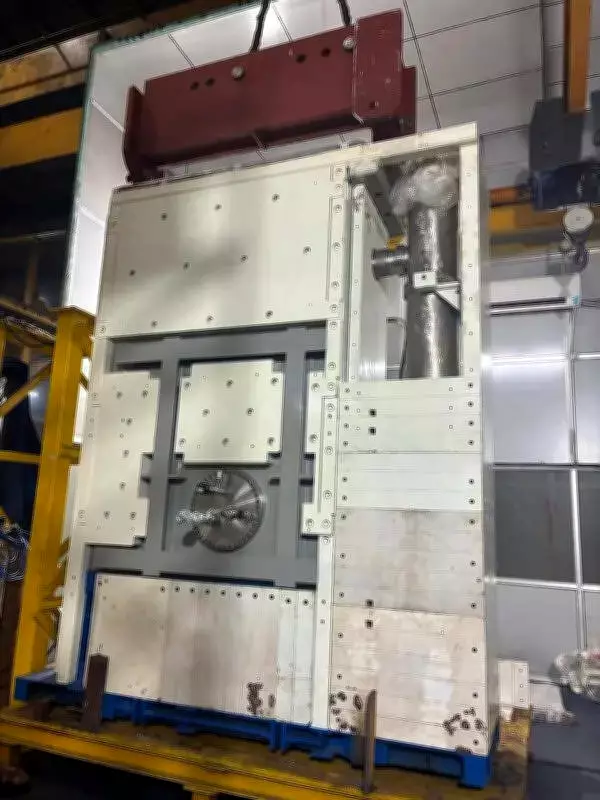
India Achieves Scientific Milestone with First Indigenous Beam Catcher Shipment to Germany
In a significant leap for global scientific cooperation, India has successfully dispatched its first indigenously designed and manufactured Beam Catcher unit to the Facility for Antiproton and Ion Research (FAIR) in Darmstadt, Germany. This landmark event underscores India's growing prowess in advanced engineering and its commitment to international research endeavors.
Key Details of the Indo-FAIR Initiative
The shipment, which marks a pivotal moment in the Indo-FAIR initiative, was coordinated from the Bose Institute in Kolkata, serving as the nodal agency. This initiative is jointly funded by the Department of Science and Technology and the Department of Atomic Energy, highlighting strong governmental support for cutting-edge scientific projects.
The Beam Catcher unit, a sophisticated engineering marvel, was fully engineered and manufactured within India. It was shipped from the Kanpur facility of Trident Auto Components, showcasing the capabilities of Indian industry in producing high-precision components for global scientific infrastructure.

India's Role in the FAIR Project
India holds a unique position as a founding member and the only non-European shareholder in FAIR GmbH, the entity overseeing the project. The Director of Bose Institute represents the Government of India as a shareholder, emphasizing the nation's strategic involvement in this ambitious particle accelerator project.
Beyond the Beam Catcher, Indian industry is contributing critical components to FAIR, including:
- Ultra-high vacuum chambers
- Specialized diagnostic and IT cables
- High-stability power converters
These contributions are integral to the facility's construction and future operations.
Technological Significance and Future Impact
The Beam Catcher is described as a flagship Indian contribution, integrating heavy-duty fabrication with precision motion systems and high-vacuum technology. Its design and manufacture within India demonstrate the country's ability to meet international standards in complex scientific equipment.
FAIR, one of the world's most ambitious particle accelerator projects currently under construction, is poised to revolutionize high-energy physics, nuclear science, and plasma research. Once operational, it is expected to open new pathways in diverse fields such as:
- Space science advancements
- Advanced cancer therapies
- Fundamental particle research
This project not only enhances India's scientific reputation but also provides opportunities for Indian scientists to participate in groundbreaking experiments at the facility.
Broader Implications for Indian Science and Industry
The successful shipment of the Beam Catcher unit reflects India's strategic focus on enhancing its global scientific engagement. It aligns with broader efforts to boost indigenous manufacturing and technological innovation, positioning India as a key player in international research collaborations.
As the project progresses, it is anticipated to foster further partnerships between Indian institutions and global scientific communities, driving advancements in both theoretical and applied sciences. This milestone sets a precedent for future contributions to large-scale international projects, reinforcing India's role in shaping the future of scientific discovery.