

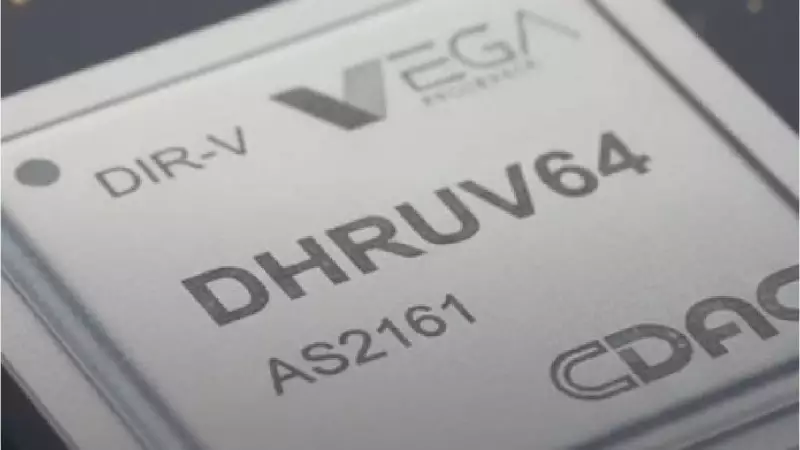
In a landmark achievement for India's technological sovereignty, the nation has unveiled its first indigenously designed 1.0 GHz 64-bit dual-core microprocessor. Named Dhruv64, this pioneering chip marks a significant leap forward in India's quest for self-reliance in the critical semiconductor domain.
The Genesis and Significance of Dhruv64
The development of the Dhruv64 microprocessor is the culmination of a dedicated research and development effort aimed at reducing India's dependency on foreign semiconductor technology. This processor is not just a component; it represents a strategic asset for national security, economic growth, and technological innovation. By mastering the design of such complex computing cores, India positions itself among a select group of nations with advanced microprocessor design capabilities.
The processor operates at a clock speed of 1.0 GHz and is built on a 64-bit architecture, which is the modern standard for handling large amounts of data efficiently, crucial for everything from consumer electronics to high-performance computing and defense systems. The dual-core design means it contains two independent processing units on a single chip, allowing it to handle multiple tasks simultaneously and improve overall performance and efficiency.

Technical Specifications and Capabilities
Delving into its technical prowess, the Dhruv64 microprocessor is engineered to meet the demands of contemporary computing. The 64-bit architecture enables it to access vastly more memory compared to older 32-bit processors, which is essential for advanced applications, data analytics, and complex algorithms. Operating at 1.0 GHz provides a solid balance of performance and power consumption, making it suitable for a range of applications.
Key potential applications for this indigenous microprocessor include:
- Strategic and Defense Systems: Secure communication, radar, and navigation systems where control over the hardware is paramount for security.
- Consumer Electronics: Smart devices, set-top boxes, and IoT products that require reliable and efficient processing.
- Industrial Automation: Control systems for manufacturing and infrastructure that benefit from localized, secure technology.
- Research and Education: Serving as a platform for academic institutions to build curriculum and research around native chip design.
This development is a cornerstone for the government's ambitious Digital India and Make in India initiatives, showcasing the country's growing prowess in deep-tech domains beyond software services.
A Milestone for Atmanirbhar Bharat and Future Roadmap
The successful design of Dhruv64 is a testament to the collaborative efforts between academia, research institutions, and government support. It underscores a critical step towards an Atmanirbhar Bharat (Self-Reliant India) in electronics. While designing the microprocessor is a monumental task, the next frontier lies in achieving end-to-end sovereignty, which includes domestic manufacturing or fabrication of these chips.
Currently, most semiconductor fabrication plants (fabs) are located outside India. The creation of Dhruv64 powerfully demonstrates India's design capabilities and strengthens the case for establishing advanced semiconductor manufacturing units within the country. This would complete the value chain, from design to finished silicon, insulating the nation from global supply chain disruptions and creating a robust electronics manufacturing ecosystem.
The unveiling of Dhruv64 is more than a technical announcement; it is a statement of intent. It proves that Indian engineers and scientists can conceptualize and design world-class microprocessor cores. This breakthrough is expected to catalyze further innovation, attract investment in semiconductor design startups, and inspire a new generation of hardware engineers. It lays a foundational stone upon which India can build a future less dependent on imported core technologies, fostering innovation across sectors from telecom to automotive and beyond.






