

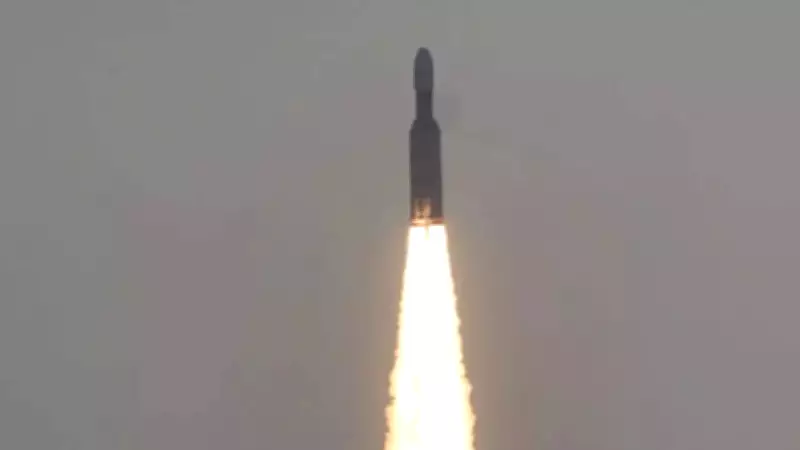
New Delhi: India's space industry has rapidly transformed into a dynamic, technology-driven, and commercially vibrant segment of the nation's services economy. According to the Economic Survey 2025-26, this sector is currently valued at an impressive $8.4 billion, accounting for approximately 2% of the global space market. Over the next ten years, it is projected to expand dramatically to $44 billion, fueled by robust growth in launch services, satellite communications, earth observation, navigation, and an increasingly active private ecosystem.
Commercial Launches: A Major Export Driver
Commercial space launches have emerged as a significant source of export revenue for India. Between 2015 and 2024, the country successfully launched 393 foreign satellites for 34 different nations. This achievement has generated substantial earnings, including nearly $143 million from United States launches and Euro 272 million from European launches, highlighting India's reputation for cost-effective and reliable launch capabilities on the global stage.
Strengthening Commercialization Through NSIL
The commercialization of India's space activities has been significantly bolstered by the Indian Space Research Organisation's commercial arm, NewSpace India Limited (NSIL). Its revenues have witnessed a remarkable surge, rising from Rs 322 crore in the fiscal year 2020 to Rs 2,940 crore in FY23. Projections indicate further growth, with revenues expected to reach Rs 3,246 crore in FY25. Additionally, satellite-enabled services are experiencing rapid expansion, with India's satellite data services market valued at $495 million in 2024.

Recent Milestones and Global Collaborations
India currently operates 56 active space assets, and the year 2025 has been marked by several landmark achievements for the national space program, showcasing indigenous technological advancements and an expanded international presence.
Notably, India became the fourth country globally to achieve autonomous satellite docking through the successful SpaDeX (Space Docking Experiment) mission. On January 29, 2025, the GSLV-F15 rocket, equipped with an indigenous cryogenic stage, launched the NVS-02 satellite, commemorating the 100th lift-off from the Sriharikota launch site.
Global partnerships reached new heights with the successful completion of the Axiom-04 mission in July 2025. This collaborative spirit was further reinforced by the launch of the NASA-ISRO NISAR mission in the same month. In December 2025, the LVM3-M6 vehicle successfully placed the United States' BlueBird Block-2 communication satellite into its intended orbit, underscoring India's growing role in international space ventures.
Ambitious Targets Under Space Vision 2047
Aligned with India's ambitious Space Vision 2047, the government has approved five key strategic projects to propel the nation's space ambitions forward. These include the Gaganyaan follow-on mission, which will pave the way for establishing the first module of the Bhartiya Antariksh Station (Indian Space Station). Other critical missions are the Chandrayaan-4 lunar sample return mission, the Chandrayaan-5/LUPEX mission, a Venus Orbiter Mission, and the development of a Next Generation Launch Vehicle.
Enhancing Private Participation in the Space Sector
The Space Sector Reforms of 2020, followed by the Indian Space Policy–2023, have established a structured and forward-looking framework to encourage private-sector involvement and amplify India's position in the global space economy. Recent achievements and key initiatives to promote private participation include:

- The emergence of over 300 space startups, driving innovations across various space technologies and services.
- IN-SPACe functioning as a single-window agency to promote, regulate, and authorize activities of Non-Governmental Entities (NGEs), ensuring streamlined governance and support.
- A liberalized Foreign Direct Investment (FDI) policy, permitting up to 100% foreign investment through the automatic route in less sensitive categories, with graded caps of up to 74% or 49% for more sensitive segments.
- Cabinet approval of a Rs 1,000 crore venture capital fund under IN-SPACe in October 2024 and the launch of a Rs 500-crore Technology Adoption Fund in February 2025 to accelerate the growth of space startups and technology-led advancements. Successful sub-orbital launches by companies like Skyroot Aerospace in 2023 and Agnikul Cosmos in 2024 demonstrate this momentum.
- Successful satellite launches by NGEs such as Pixxel Space, Azista, Hex20, and TakeMe2Space, indicating a rise in indigenous manufacturing and operational capabilities.
- More than 70 technology transfers from ISRO to private industry, facilitating commercialization and scaling of space technologies.
- The ongoing establishment of a dedicated launchpad and integration facility at Kulasekarapattinam in Tamil Nadu, which will significantly strengthen India's launch infrastructure and capacity.
These developments collectively signal a transformative phase for India's space sector, blending governmental vision with entrepreneurial energy to secure a leading role in the new space age.





