The Cosmic Challenge: Can Humans Travel to Another Galaxy?
Space remains one of humanity's greatest frontiers, filled with mysteries that ignite curiosity and wonder, especially among younger generations. From the twinkling stars visible in our night sky to distant planets and sprawling galaxies, the universe reveals itself to be far more expansive than we can fully comprehend. This cosmic scale naturally leads to profound questions about our place within it and our potential to explore beyond our celestial neighborhood.
The Fundamental Question of Intergalactic Travel
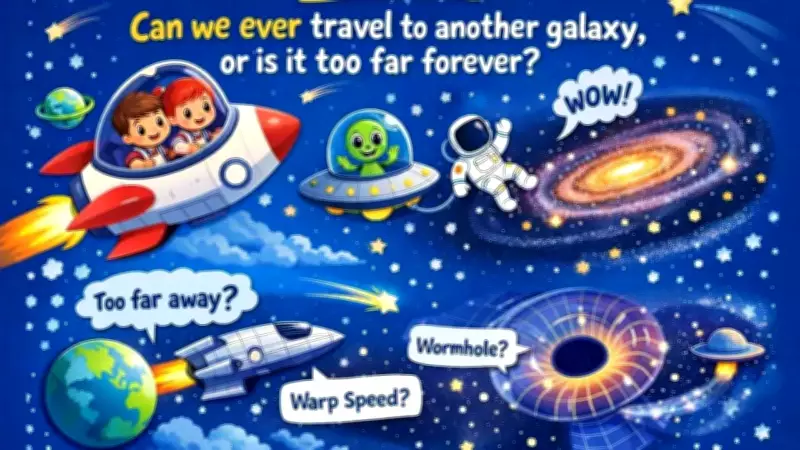
Many children and space enthusiasts alike wonder whether humans could ever travel beyond our own galaxy to reach the distant galaxies that dot the cosmos. Scientists and space researchers have dedicated decades to studying the possibilities of extended space travel. While humanity has successfully reached the moon and sent probes to other planets within our solar system, journeying to another galaxy presents challenges of an entirely different magnitude.
Understanding the Vastness of Galaxies
To grasp why intergalactic travel is so formidable, we must first understand what a galaxy truly is. A galaxy is an enormous collection of stars, planets, gas, and dust, all bound together by gravity. Our home, Earth, resides within the Milky Way Galaxy, which contains billions of stars, including our Sun. Beyond our galaxy, there exist countless others, such as the famous Andromeda Galaxy. The distances between galaxies are staggeringly vast, far exceeding the spaces between planets or even stars within a single galaxy.

The Immense Distances Between Galaxies
The primary obstacle to intergalactic travel is the sheer distance involved. The Andromeda Galaxy, our closest galactic neighbor, lies approximately 2.5 million light-years away. A light-year represents the distance light travels in one year, and light is the fastest entity known in the universe. Even traveling at the speeds achieved by our fastest spacecraft, it would take millions of years to reach another galaxy. This highlights the incomprehensible scale of the cosmos. When we observe distant galaxies through telescopes, we are essentially looking back in time, seeing them as they appeared millions of years ago due to the time it takes their light to reach us.
Current Technological Limitations
At present, humanity possesses no spacecraft capable of traveling to another galaxy. Voyager 1, the farthest human-made object from Earth, remains within the confines of our Milky Way. While scientists are actively researching advanced propulsion technologies, such as theoretical concepts like warp drives or faster-than-light travel, these ideas remain in the realm of speculation rather than practical application. Thus, intergalactic travel is currently beyond our technological reach.
Future Possibilities and Scientific Optimism
Despite the daunting challenges, many scientists maintain hope that future generations may develop technologies to make intergalactic travel feasible. History has shown that what once seemed impossible—such as landing humans on the moon with the Apollo 11 mission—can become reality through technological advancement. Potential future solutions include generation ships, where multiple generations live aboard a spacecraft during the long journey, or breakthroughs in propulsion that drastically reduce travel time. While not achievable today, the future of space exploration holds intriguing possibilities.
The Importance of Space Education and Curiosity
Even if traveling to another galaxy remains a distant dream, studying space is crucial for expanding our understanding of the universe. Through powerful telescopes, scientists have discovered distant galaxies, stars, and planets, shedding light on cosmic formation and evolution. This knowledge not only satisfies human curiosity but also inspires future innovators. The children learning about space today may one day develop the technologies needed to turn intergalactic travel from science fiction into science fact. The journey begins with curiosity, the first step toward making the impossible possible.