

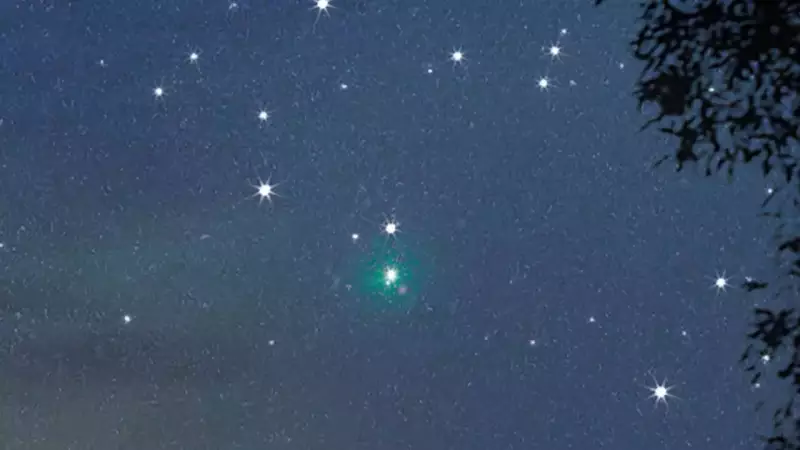
In a celestial event that has the global astronomy community buzzing with anticipation, a rare visitor from beyond our solar system is set to make its closest approach to Earth. Astronomers are preparing their telescopes for December 19, 2025, when the interstellar comet 3I/ATLAS will swing by our planet, offering a fleeting but invaluable opportunity to study material from another star.
A Rare Visitor from the Cosmic Void
This intriguing icy wanderer, officially designated 3I/ATLAS, is only the third confirmed interstellar object ever detected entering our solar system. Its discovery was made on July 1, 2025, by the NASA-funded ATLAS (Asteroid Terrestrial-impact Last Alert System) telescopes located in Chile. It follows in the footsteps of the enigmatic 1I/'Oumuamua in 2017 and the more comet-like 2I/Borisov in 2019.
What truly sets this comet apart is its origin and path. Unlike the vast majority of comets that orbit our Sun in predictable, elliptical paths, 3I/ATLAS is a true interstellar traveller. It originated from a distant star system and is merely passing through our neighbourhood on a one-way journey. Its high speed and hyperbolic trajectory confirm that it is not gravitationally bound to our Sun and will eventually depart back into the depths of interstellar space.

The Safe but Significant December Encounter
While the term "close approach" might sound alarming, there is absolutely no cause for concern. On December 19, the comet will maintain a very safe distance of approximately 1.8 Astronomical Units (AU) from Earth. To put that in perspective, one AU is the average distance between Earth and the Sun. This means the comet will be about 270 million kilometres away—nearly twice the Earth-Sun distance. It poses zero threat of collision with our planet or any other in the solar system.
This safe distance, however, is perfect for scientific observation. It allows powerful ground-based and space-based telescopes to study the comet in detail without the glare of being too close. As the comet journeys toward the inner solar system and heats up, solar radiation causes its icy nucleus to sublimate, releasing gas and dust. This forms a bright cloud around the nucleus called a coma and often a faint tail, both of which are prime targets for analysis.
Scientific Goldmine and How to Witness the Event
The scientific value of observing 3I/ATLAS cannot be overstated. By analysing the light reflected and emitted by its coma and tail, researchers can determine the comet's chemical composition. This provides a direct sample, albeit a remote one, of the building blocks from another planetary system. Studying this interstellar material offers clues about the formation of planets and the chemical diversity of our galaxy, offering a comparative benchmark for our own solar system's history.
For amateur astronomers and space enthusiasts: The comet will not be visible to the naked eye due to its distance and faintness. However, you can still witness this historic event. The Virtual Telescope Project will host a live online observing session, streaming the comet's view through professional telescopes. The webcast is scheduled for 11:00 PM EST on December 18 (04:00 GMT on December 19), weather permitting. This offers a unique chance for anyone with an internet connection to gaze upon a visitor from between the stars.
Major observatories, including the Hubble Space Telescope and instruments like the JUICE spacecraft (en route to Jupiter), have already begun capturing data. The observations collected during this flyby will fuel scientific studies for years to come, contributing to our understanding of planetary evolution, interstellar chemistry, and the dynamics of small bodies in the galaxy.

As 3I/ATLAS continues on its solitary path out of our solar system, the December encounter stands as a historic milestone. It reminds us that our cosmic neighbourhood is dynamic and that we now possess the technology to detect and study these rare messengers from other suns, unlocking secrets of the universe one distant comet at a time.





